
A buyer in Bac Ninh can have a truck of sanitary pants at his door before a container would have finished clearing at Hai Phong. He pays less per carton, collects at a land gate, and receives no bill of lading at all. That last detail is where the difficulty starts: a claim is assembled out of documents, and this route was never built to produce them.
A Sanitary Pants Supplier in Vietnam Does Not Pick One Route for Every Buyer
The first correction is worth stating plainly. Goods crossing at Huu Nghi, Mong Cai or Lao Cai are not slipping through informally. They are declared, valued and released at a land port with full customs authority, and origin preference is claimed there exactly as it would be at sea. What differs is the document set, not the legality. Buyers who search for a sanitary pants supplier in Vietnam are looking for a plant that can serve the market, not a plant inside it.
An ocean shipment creates three things in one act: a carrier's receipt, a contract of carriage, and a document of title a bank will hold. A truck creates the first two. The border waybill proves the goods were handed to a carrier and records the freight terms, but it does not represent the cargo, so nobody can hold it and stop the load moving.
That absence reorganises the money. Payment cannot lean on a document the route never issues, so the terms have to carry the risk themselves: an advance, a deposit released against a copy of the export declaration, or open account with a buyer whose record you already know. A buyer asking for letter of credit terms on a land route is asking for a mechanism with nothing to attach to.
What Replaces the Bill of Lading on a Land Route
Title still has to move at some identifiable moment, and here the moment is usually a delivery note signed at the gate plus a payment record. Those two are adequate between parties who already trust each other, and thin between parties who do not, because neither of them is negotiable.
The workable fix is contractual rather than documentary. Name the transfer point in the sales contract, name who carries the transit leg, and name what the signature on the note is taken to acknowledge. A clause saying risk passes when the Vietnamese truck is loaded at the transfer yard is worth more than a folder of photographs taken a week later.
Buyers who import sanitary pants from China to Vietnam for the first time assume the missing paperwork can be reconstructed afterwards. It cannot. The declaration does exist in the customs system, but the title question was settled when the goods moved, and no later document goes back and settles it differently.
The Load Changes Trucks at the Border, and the Carton Absorbs It
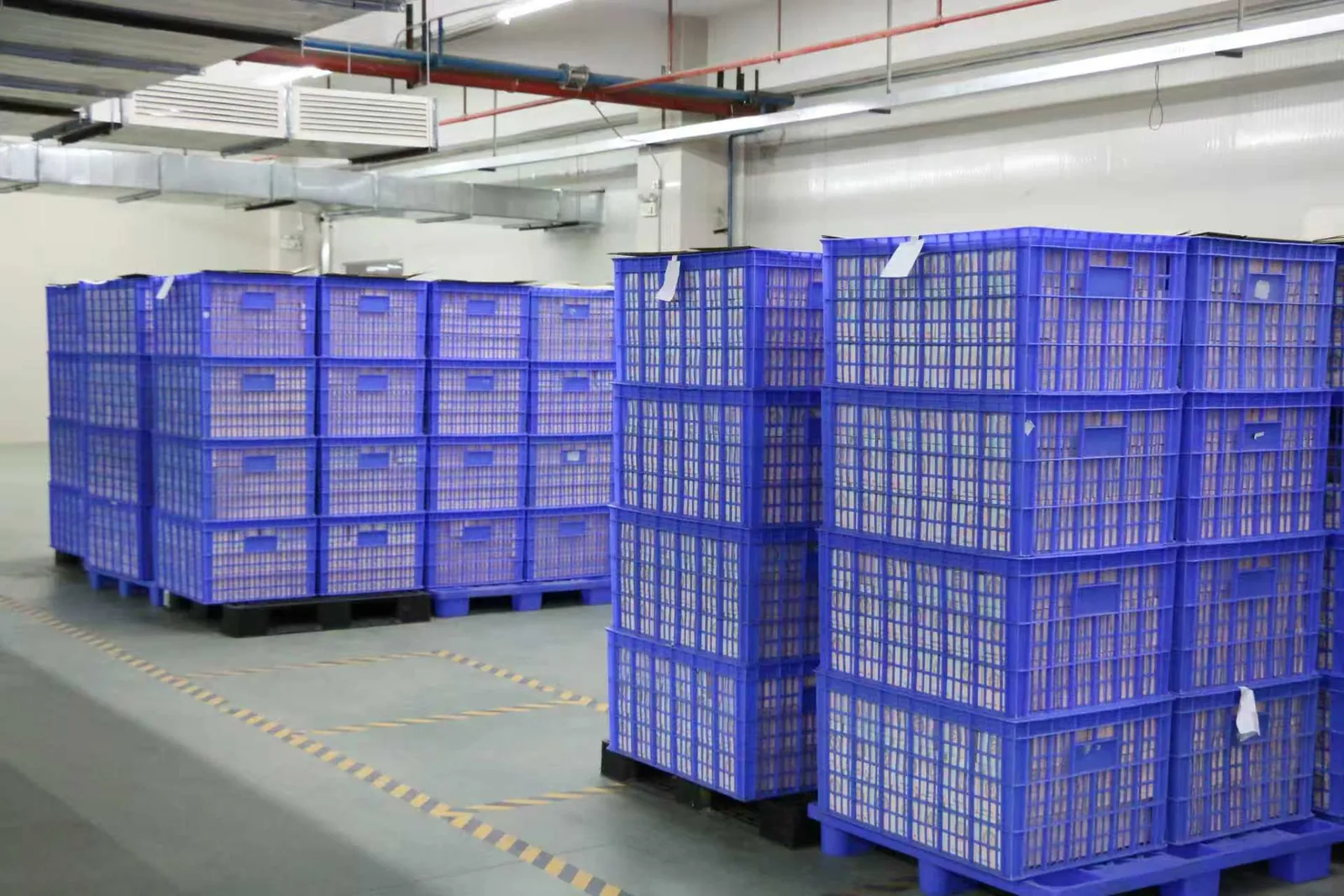
A Chinese tractor unit does not run Vietnamese domestic roads, so the cargo is taken off in the transfer yard and put onto a Vietnamese truck. That is a second loading event, and it is the second time every carton in the stack is lifted, set down and leaned on.
Inside a container the carton is protected by the walls and by the fact that the stack does not move between stuffing and devanning. On the land leg there is no container at all: the carton is the handling unit, the stack is rebuilt by hand or by forklift, and the corners take the load. Nothing about the film or the core changes; the packaging simply meets a different force.
This is why a board grade copied from an ocean order can disappoint here. What the transfer actually demands is a stated stacking height, and a stated compression the filled carton must survive, measured on the finished carton rather than on a board sample. If the yard handles loose boxes, ask for the load to be palletised: our packing capability builds either way, and the choice has to be fixed before the cartons are printed.
Form E Has to Match the Invoice That Clears
Origin preference under the ASEAN-China arrangement rests on a certificate of origin issued in China, and the document is only as good as its consistency with the invoice the importing customs sees. Numbers, consignee, description and quantity have to line up. A certificate describing one shipment and an invoice describing another is treated as no certificate at all.
The detail that catches traders is third-party invoicing. When a border trader in Lang Son is the seller on the declaration rather than the factory, the invoicing party is not the shipper, and the certificate has to record that arrangement in the box reserved for it. Left unticked, the preference is lost at the receiving end. A buyer who asks a sanitary pants manufacturer in Vietnam for a delivered-gate price is usually talking to a trader who consolidates loads, not to a plant.
There is a second consequence, less visible. If the factory name never appears on the import file, the traceability chain starts at a trader, and a defect conversation six weeks later begins with a party who did not make the goods. A buyer who picked a sanitary pants supplier in Vietnam on price alone accepted exactly that file.
The Vietnamese Label Is Made After the Goods Land
Vietnam requires an auxiliary label in Vietnamese on imported consumer goods, and that sticker is the importer's act, not the factory's act. It carries the importer's name and address, the origin, the contents and the date information, and it is applied after release, at the importer's premises, before the goods are offered for sale.
This is good news for a buyer who changes distributor, because a printed film without Vietnamese text does not need a new printing plate when the importer changes. It is bad news for anyone who assumes the label question closed at the gate. A sticker that omits a required line, or that lands over the printed date, holds goods the customs authority already released.
The two systems also collide physically. The date is printed on the film at the packing station, and the sticker is placed on the same face weeks later. Ask where it will sit before approving artwork, and keep that area clear of any printed line the sticker must not cover.
The Lines the Carton Must Carry Before It Ships
What has to survive translation are the lines that are read before anything is opened, because every Vietnamese word will be added later by someone else.
| Line on the carton | Why it survives the border | Who reads it |
|---|---|---|
| Item code and pack count per carton | Read at the transfer yard, where nothing is opened | The yard and the importer |
| Size ratio inside the carton | The stack is rebuilt by hand, so the ratio must be readable from outside | The importer's dispatch team |
| Gross weight and outer dimensions | The land leg bills on volume, not on the freight ton | The forwarder and the receiving dock |
| Country of origin marking | A marking duty on the goods themselves, separate from the label | Customs, at the gate |
| Batch or lot reference | It links this carton to one inspection record | Whoever handles a claim |
Note what is absent from that list: brand, claims, and any Vietnamese sentence. Those belong to the label layer, and printing them on the film is what makes an order inflexible for the next distributor.
The Claim Window Closes When the Truck Leaves the Gate
The signature on the delivery note is a receipt, and an unqualified receipt says the goods arrived in the condition described. Once the truck is out of the yard, the only evidence left is what somebody photographed, and pictures taken at the buyer's premises prove condition at that moment, not at handover.
The cheap moment to inspect is before the truck is released. A joint check at the gate does not need to be exhaustive; it needs to be counted, written down and signed by both sides, and it needs to record what was not checked. A note saying the cartons were counted but not opened is worth far more than silence.
If inspection is impossible, say so on the receipt. A qualified signature, stating that goods were received unchecked because of time or access, keeps the later claim alive. That one sentence is the difference between a conversation and a refusal.
Ask for a Price That Names the Route
A price without a route is not a price, it is an opening position. Delivered at a named gate, delivered at the importer's premises, and cost and freight to a seaport are three products with three different packing plans behind them. Our wholesale terms are written against a named port for that reason.
For a buyer comparing sanitary pants wholesale in Vietnam across two or three sources, the useful request is narrower than a quotation: which gate, which packing unit, who prepares the origin certificate, and who applies the sticker. Those four answers explain most of the gap between two numbers that look alike. The first order size decides whether a pallet is worth building at all.
Send the gate you clear at, the carton count you expect on the first order, and the label text your importer intends to print. We will mark which lines change the packing plan and which only change the paper. If you are still shortlisting a sanitary pants supplier in Vietnam, start with the gate, because everything else follows from it. Our pants line ships from China and we do not hold stock locally, so the route is the part worth agreeing on first.
Frequently Asked Questions
Do I need a bill of lading for a truck shipment into Vietnam?
No. A land crossing produces a border waybill and a delivery note, not an ocean bill of lading. The waybill proves carriage and records freight terms, but it does not represent the cargo, so it cannot work as a title document.
Is a land border gate cleared under different rules from a seaport?
The declaration, valuation and origin treatment are the same in kind. What differs is the transport document set and the handling: the load is transferred between trucks, and title never sits inside a negotiable document.
Who applies the Vietnamese label on imported sanitary pants?
The importer does. The auxiliary label is added after release, at the importer's premises, and it carries the importer's name and address, the origin, the contents and the date information. The factory prints only brand and logistics lines.
Why do cartons suffer more on a land route than inside a container?
Because the cargo is taken off at the transfer yard and rebuilt onto another truck. The carton becomes the handling unit and the stack is re-formed by hand or forklift, so corner compression matters more than the shelter a container wall gives.
Can a defect claim still be made once the truck has left the gate?
Only if the receipt was qualified or a joint check was recorded. An unqualified signature states that goods arrived as described, and photographs taken later prove condition at that point rather than at handover.


