Home >> Brand >> NAFY
NAFY · Brand Story

NAFY: soft protection for everyday life and overnight rest.

NAFY is the comfort arm of the Nafei brand family. It was built for the hours that ask the most of a product and reward it the least: a long shift, a night's sleep, a commute that runs late. The brief was not to add features. It was to remove friction, then keep the result repeatable order after order.

  • Soft through-air-bonded skin contact
  • Wood pulp and SAP core, batch after batch
  • Made in Shanwei, Guangdong since 1998
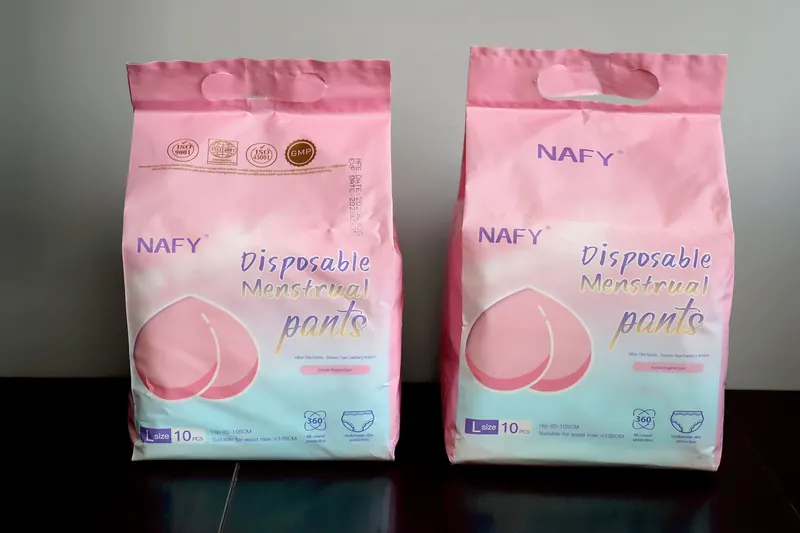
NAFY disposable menstrual pants pack for daily life and overnight use, soft skin contact and a quiet fit
Why NAFY Exists

A brand built from complaints, not from a mood board.

NAFY did not start with a logo. It started with a pattern in the feedback our OEM customers kept sending back from their own retail shelves.

Woman in natural light representing everyday comfort during a long day
01

Start with the complaint

The same three words came back from different markets: stiff, loud, hot. A pant that rustles when someone stands up, or presses a seam into the hip after four hours, fails no matter how good the absorbency number looks on a spec sheet.

Close view of soft nonwoven material used for the NAFY skin contact layer
02

Fix the contact layer first

Everything a wearer actually feels happens in the first two millimetres. NAFY moved the budget toward a through-air-bonded nonwoven at 20 gsm, a material that stays soft under compression instead of going flat and papery.

Globe representing the export markets NAFY ships to
03

Then make it repeatable

A soft sample is easy. A soft container is not. NAFY was designed around process control: fixed material suppliers, fixed core recipes per size, fixed compression settings on the line, so the tenth order feels like the first.

Most feminine care brands are built from the top down. Someone decides on a positioning, a price band and a colour palette, then works backward to a product that fits. NAFY was assembled the other way. We had production data from years of private label runs, and we had the complaint logs that came with it. The complaints pointed at a specific gap: the market was well served at the premium end and well served at the cheapest end, and thin in between.

That middle space is not a marketing invention. It is a real buyer. A pharmacy chain in a secondary city wants a product that does not embarrass the store next to an imported brand, but cannot carry imported landed cost. A distributor in a humid climate wants a pant that survives a warehouse without climate control and still feels acceptable on the shelf six months later. A private label buyer wants a base specification solid enough to put their own name on without a factory visit every quarter.

NAFY answers those three buyers with one product architecture and three pack presentations. The architecture is deliberately conservative. We are not chasing a novel material or a new shape. We are trying to make a familiar product behave predictably, because predictable is what a distributor can actually plan a season around.

There is also a commercial reason the brand exists inside a factory that already runs private label work. Running NAFY ourselves keeps us exposed to the same pressures our buyers face: shelf competition, pack sizes that must fit a specific peg, price points that leave no room for a premium material. We sell into those constraints under our own name, so when a buyer describes them we are not translating from theory.

The Formats

Two formats, one comfort standard.

NAFY runs a pant format for extended wear and a pad format for everyday rotation. They share a material philosophy but not a construction, because the failure modes are different.

NAFY 10-piece menstrual pants pack in L size, English retail packaging

10-Piece Menstrual Pants

L and XL, ten pieces per pack, thirty-six packs per carton. The extended-wear format for overnight and long days.

→
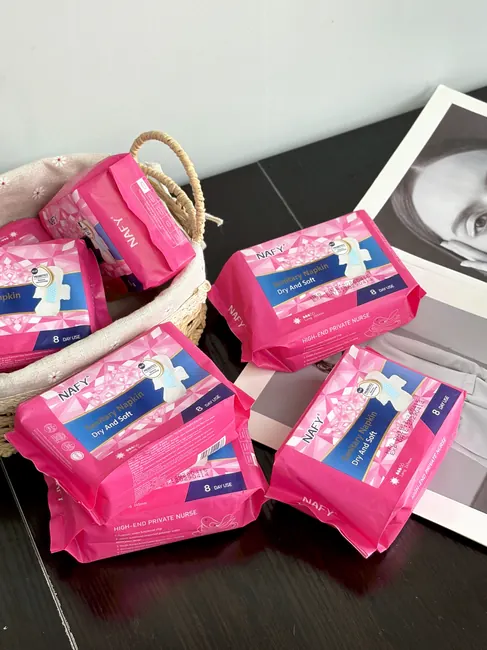
NAFY sanitary pads in 245 mm day and 290 mm night formats with wings

245 mm Day / 290 mm Night Pads

Slim winged pads with an individual wrap. Eight day pads or seven night pads per pack, 175 packs per carton.

→

The pant format, in numbers

The menstrual pant is the harder of the two products to get right, because it has to hold position on a moving body for eight hours or more. Absorbency is necessary but not sufficient. The waistband has to stay put without digging in, the side seams have to survive a night of turning, and the leg opening has to seal without leaving a mark.

NAFY solves this with a wide elastic waistband rather than a narrow one, a core that extends further forward and back than a standard pad core, and a leg gather that is tensioned per size rather than scaled by a single ratio. The result is a pant that reads as underwear rather than as a medical garment, which matters more to repeat purchase than any specification line.

10pieces per pack, 36 packs per carton
20gsm through-air-bonded contact layer
4 / 5g wood pulp in L and XL, plus 1.5 g SAP
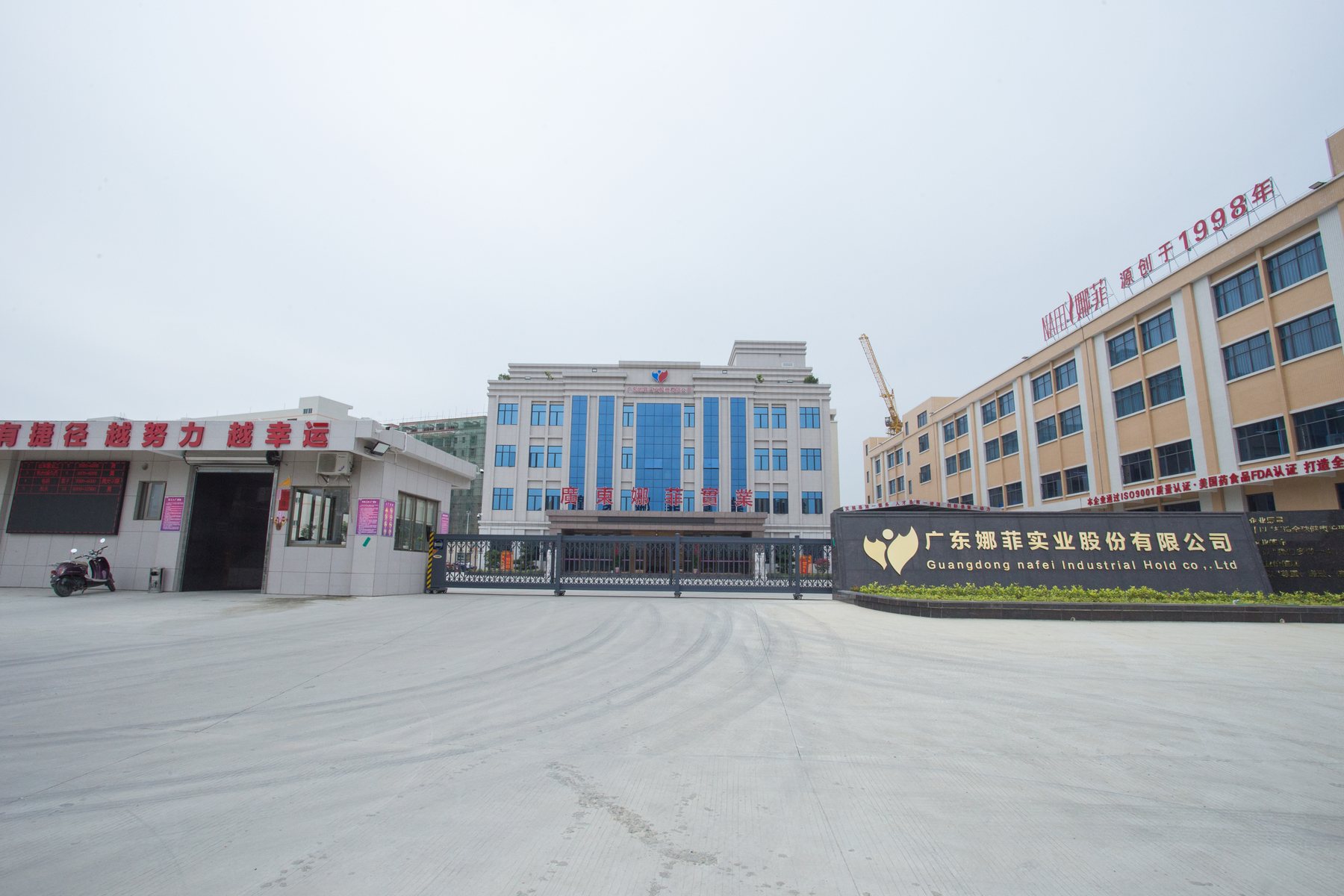
Nafei production facility in Shanwei, Guangdong, where NAFY is manufactured

The pad line works on a different logic. A pad is changed several times a day, so the experience that matters is not endurance but the moment of change: how easily the wrapper opens, whether the adhesive releases cleanly from the underwear, whether the pad stays flat when it is applied in a hurry. NAFY pads use an individual PE wrap rather than a folded paper pouch for exactly this reason. The wrap opens with one hand and does not tear down the middle of the pad.

The 245 mm day pad and the 290 mm night pad share a topsheet and a core family but differ in length, wing placement and adhesive pattern. The night pad carries a wider rear adhesive zone because the failure mode overnight is shifting rather than overflow. The day pad keeps the adhesive narrower so it releases without pulling the fabric on a quick change.

Both formats are available in English retail packaging as standard, with other languages handled through the private label programme. That distinction matters for a distributor testing a new market: they can start with a ready English pack, measure sell-through, and only then commit to a localised print run.

Inside The Pack

A closer look at the pack, the pant and the core.

A specification sheet answers the buyer's question. Photographs answer the shopper's, which is a different one: does this look like something I would take off a shelf twice. Here are the four surfaces that decide it, in the order a person meets them.

Woman resting in a NAFY disposable menstrual pant during an overnight sleep
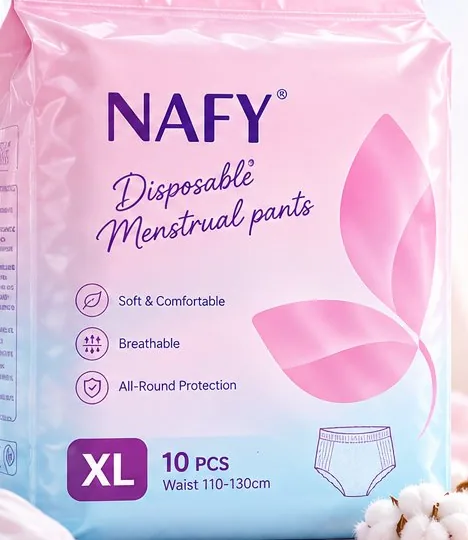
NAFY disposable menstrual pants pack, XL size, 10 pieces, for a waist of 110 to 130 cm
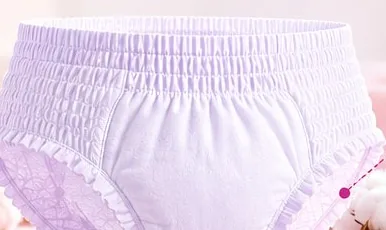
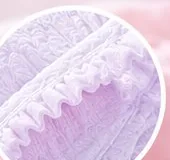
NAFY menstrual pant laid flat, showing the elastic waistband and the lace-trimmed leg opening Close view of the gathered elastic and lace trim at the leg opening of a NAFY pant
Embossed through-air-bonded nonwoven surface used on the NAFY topsheet

Soft, low-friction topsheet

A 20 gsm through-air-bonded nonwoven. The fibre loft stays open under compression, so the surface does not compact into a flat sheet after a few hours of wear.

Superabsorbent polymer granules on the NAFY absorbent core under a water droplet

Absorbent core

Wood pulp spreads liquid sideways, superabsorbent polymer locks it under pressure. 4 g pulp with 1.5 g SAP in L, 5 g pulp with 1.5 g SAP in XL.

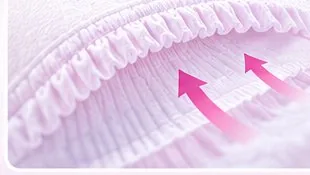
Elastic waistband and gathered leg opening on a NAFY menstrual pant

All-round fit

A wide elastic waistband and a leg gather tensioned per size rather than scaled from one ratio, so the pant holds position through a night of movement.

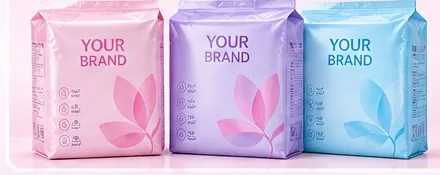
Three NAFY private label packs printed with customer artwork in pink, purple and blue

Private label OEM / ODM

The same construction under your own artwork, in three film colours as standard. The starter minimum is 10,000 pieces per size.

The bag is the part of the product most buyers judge first, and they judge it in about two seconds. NAFY runs a matte film rather than a high-gloss one, because gloss reads as inexpensive under supermarket lighting and shows every crease after a week on a peg. The hang hole is punched with a reinforced collar so the bag does not tear at the top after repeated handling, which is a failure that shows up in a stock room rather than in a laboratory.

The pack above is the XL, ten pieces, for a waist range of 110 to 130 cm. The size range matters more than it looks. A pant one size too large gaps at the leg, and one size too small pulls at the waistband, so both errors end as the same complaint. NAFY prints the range in centimetres on the front panel instead of relying on a letter alone, because a buyer in a market where sizing conventions differ should not have to guess which letter applies.

The pant itself is a laminated structure rather than a sewn garment, which is why the side seams are welded and the leg opening is finished with a gathered elastic instead of a stitched hem. The close-up shows that gather and the lace trim sitting over it. The trim is decorative, but it also covers the elastic channel, which keeps the gather from reading as a raw edge against the hip.

What a photograph cannot show is the part that decides repeat purchase: how the topsheet behaves after two hours under body weight, and whether the back sheet lets heat out. Both are measurable, and both are specified per SKU rather than left to the line. That is also why the fourth card is a process rather than a material. The same construction leaves the factory under a buyer's own artwork every week, which is the honest answer to how a NAFY specification was arrived at in the first place.
Materials & Structure

What actually sits against the skin.

A feminine care product is a stack of thin layers, and almost every complaint traces back to one of them. Here is what NAFY uses and why each layer was chosen.

Contact layer

A 20 gsm through-air-bonded nonwoven on the pant, 18 gsm on the thin pant variant. Through-air bonding keeps the fibre loft open, so the surface stays soft under body weight instead of compacting into a flat sheet.

Absorbent core

Wood pulp blended with superabsorbent polymer. The L pant carries 4 g pulp with 1.5 g SAP, the XL carries 5 g with 1.5 g. The pulp spreads liquid laterally, the SAP locks it in place under pressure.

Back sheet

A breathable film that blocks liquid while letting vapour escape. This is the layer that decides whether a product feels hot after two hours. A non-breathable film is cheaper and is the single most common cost-down we refuse.

Adhesive

Hot-melt construction adhesive between layers and a pressure-sensitive positioning adhesive on the garment side. The pattern is placed to hold the pad flat without grabbing fabric on removal.

The material decisions that matter most are the ones buyers rarely ask about. Breathability of the back sheet, for example, is invisible in a sample and obvious in a complaint six months later. A non-breathable film passes every absorbency test and still produces returns in a hot climate, because the wearer's experience is dominated by heat rather than by leakage. We specify a breathable film on every NAFY SKU and treat any request to downgrade it as a change that needs a written acknowledgement.

The second invisible decision is adhesive pattern. Too little and the pad shifts. Too much and it tears the underwear on removal, which reads to a consumer as a product defect even though it is a design choice. NAFY uses a wider zone on the night pad and a narrower one on the day pad, because the two products fail in different directions. This is a small detail that costs nothing to get right and is expensive to fix after a container has shipped.

The third is compression. A core that is compressed too hard during lamination becomes thin and stiff, which reads as cheap. A core that is too loose delaminates in humid storage. NAFY runs a fixed compression setting per SKU rather than a single plant-wide setting, so the pant and the pad each get the pressure their structure needs.

None of these choices are exotic. They are the standard decisions any competent feminine care factory makes. What differs between suppliers is whether those decisions are written down and held across orders, or renegotiated each time a buyer asks for a price reduction. NAFY exists partly to keep those decisions visible, because a brand we own is a brand we have to defend at the shelf.

Where NAFY Is Made

One site, since 1998.

NAFY is produced at the Nafei plant in Shanwei, Guangdong. The site has run feminine hygiene production since 1998, which means the institutional memory of what fails in a monsoon season is older than most brands currently on the shelf.

Structure, materials, converting, packing and export documentation all sit inside the same fence line. That matters more than it sounds. When a core recipe changes, the person who can approve it is in the same building as the line that runs it. When a buyer asks why a batch feels different, the answer comes from a record rather than from a supplier conversation.

1998feminine hygiene production on this site
2days typical sampling turnaround
25-30days bulk production after approval
See Factory Capability →
Exterior of the Nafei factory in Shanwei, Guangdong, operating since 1998
Quality & Documents

What a buyer can actually check.

Every supplier claims quality. The useful question is what evidence exists on paper and what a buyer is allowed to see before placing an order.

ISO 9001

Quality management system covering production control, inspection and corrective action.

ISO 14001

Environmental management system for the site, covering waste, effluent and energy.

ISO 45001

Occupational health and safety management across the production floor.

Batch records

Material lot numbers, line settings and inspection results retained per production run.

Export documents

Packing list, commercial invoice and certificate of origin prepared in house per shipment.

The certification that most often gets misused in this category is the one a factory does not hold. We only list management system certificates that apply to this site and this scope. If a buyer needs a product-level test report for a specific market, we commission it against the destination standard rather than reusing a report from another product.

Batch records are the more practical document. A management certificate tells a buyer that a system exists. A batch record tells them what actually happened on the day their goods were made: which material lot went in, what the line speed was, what the inspection found. When a distributor has a complaint from a single store, the batch record is what turns a vague argument into a specific answer.

We keep retention samples from each run for the agreed retention period. That is how a dispute about feel or thickness gets settled without shipping product back across an ocean. It is an unglamorous practice and it is the one buyers value most after their first problem shipment.

Market Versions

The same product, adapted for your shelf.

NAFY ships to distributors and retailers in several climate zones and retail structures. The product architecture stays constant; the pack, the language and the price band move.

Compact NAFY pack format suited to convenience retail and humid climates
01

Southeast Asia

Humid year round, so breathability and storage stability matter more than a marginal absorbency gain. Compact packs sell better in convenience channels; ten-piece packs dominate modern trade.

NAFY pad formats for Middle East and African pharmacy channels
02

Middle East & Africa

Pharmacy-led distribution rewards a pack that reads as trustworthy at arm's length. Longer night formats and clear size labelling outperform novelty artwork in these channels.

NAFY English retail pack used as a base for European private label programmes
03

Europe & Latin America

Mostly private label rather than NAFY-branded. Buyers here usually take the base specification and apply their own artwork, with local language and regulatory text handled at print.

Climate is the variable buyers underestimate. A product developed and tested in a temperate climate can arrive in a tropical warehouse and behave differently within weeks, because heat and humidity affect adhesive tack and film dimensional stability. NAFY is specified with that in mind: breathable film as standard, adhesive selected for a wider temperature band, and cartons configured so the inner packs are not compressed under load in a stacked container.

Retail structure is the second variable. In a pharmacy channel the pack is handled by staff and read by a customer standing at a counter, so the front panel has to answer the size question in under two seconds. In modern trade the pack competes on a shelf with dozens of neighbours, so colour blocking matters more than copy. The same product ships with different artwork logic depending on which of those two environments it is going into.

Price band is the third. A distributor testing a market usually wants a pack size that lands at a specific price point rather than a specific piece count. That is why the pack configuration is negotiable within the private label programme while the product specification is not: we will change the count, the bag size and the print, but we will not quietly remove the breathable film to hit a number.

Working With NAFY

How a NAFY order runs, start to finish.

Six steps, in the order they actually happen. Most delays in this category come from artwork, not from production, so the sequence is built to surface artwork problems early.

1. Brief

Product type, size, pack count, target market and target retail price. The price band drives pack configuration more than any other input.

2. Sample

About two days once specifications are fixed. Samples ship with the exact materials intended for bulk, not a laboratory approximation.

3. Artwork

Print-ready files checked against bag dimensions, print method and local labelling rules. This is where most timelines are lost.

4. Production

25 to 30 days after sample and artwork approval. Line settings are fixed per SKU and recorded against the batch.

5. Inspection

In-process checks plus final inspection on pack count, seal integrity, print registration and carton condition.

6. Shipping

Export documents prepared in house. Freight arranged by the buyer or quoted separately against the destination port.

The starter minimum for private label work is 10,000 pieces per size. That number is set by the cost of changing over a line and printing a bag run, not by a policy decision. A buyer who wants to test three sizes at once is committing to three times that, which is why many first orders start with the size that matches the destination market's dominant retail pack.

Artwork is the step worth planning for. A bag print run is expensive to redo and slow to reschedule, so a missing local language line or a barcode that does not scan at the destination costs more than the print itself. We ask for a complete artwork pack before production is scheduled, including barcode data, net content statement and any market-specific warning text.

Freight is quoted separately because it moves. A landed cost built on a freight number from three months ago is a planning error rather than a quote. We quote product on an EXW basis and provide carton dimensions and weights so the buyer's forwarder can price the move accurately.

Questions Buyers Ask

Straight answers before you enquire.

These are the questions that come up in almost every first conversation about NAFY. If yours is not here, ask it directly and we will answer it the same way.

What is NAFY?
NAFY is an own brand of Guangdong Nafei Industrial, focused on disposable menstrual pants and sanitary napkins built around soft skin contact and a quiet fit. It sits between premium imported lines and low-cost bulk products.
Where is NAFY made?
NAFY is produced at the Nafei plant in Shanwei, Guangdong, China, the same site that has run feminine hygiene production since 1998.
What pack sizes does NAFY use?
The menstrual pants line packs 10 pieces per pack, 36 packs per carton, 360 pieces total. The pad line packs 245 mm day pads at 8 pieces per pack and 290 mm night pads at 7 pieces per pack, 175 packs per carton.
Can I order NAFY under my own brand?
Yes. NAFY specifications can be produced as private label work with your own artwork, and the starter minimum is 10,000 pieces per size.
What is the absorbent core made of?
The core combines wood pulp and superabsorbent polymer. The L size menstrual pant carries 4 g wood pulp with 1.5 g SAP, the XL size carries 5 g wood pulp with 1.5 g SAP.
How long does sampling take?
Sampling runs about two days once specifications and artwork direction are confirmed. Bulk production typically takes 25 to 30 days after sample approval.
Which certifications apply to NAFY production?
The plant operates under ISO 9001, ISO 14001 and ISO 45001 management systems. Buyers can request the current scope documents during supplier review.
Is NAFY suitable for overnight use?
Yes. The menstrual pant format is designed for extended wear including overnight, with a wider core and a waistband that holds position through movement during sleep.
What markets does NAFY ship to?
NAFY ships to distributors and retailers across Southeast Asia, the Middle East, Africa, Latin America and Europe, with packaging language adapted per market.
Do you provide export documents?
Export documentation is prepared in house, including packing lists, commercial invoices and certificates of origin where the destination requires them.
Can the packaging artwork be changed?
Yes. Bag size, film structure, print method and artwork are all open to change within the private label programme, subject to minimum order quantities per SKU.
What is the difference between NAFY and LanCool?
LanCool is the flagship line built around light, thin protection. NAFY leans toward softness and a quiet fit for daily and overnight use. Both run on the same lines under the same quality system.

Stock NAFY, or build your own version of it.

Send the market, the pack count and the price band you need to hit. We will come back with a specification that fits, or tell you honestly where the cost floor sits.

Woman relaxing outdoors, representing comfortable nights and everyday confidence with NAFY
WhatsApp contact WeChat QR code

Nafei WeChat QR code