
01
Length
A pad fails at the ends more often than in the middle. A core with capacity left can still transfer liquid at the edge, which the wearer experiences as a leak. Length is the first constraint, not the last.

A sanitary pad is the simplest product in the feminine care category and the one where buyers most often choose on the wrong number. Absorbency in grams is easy to compare and rarely the reason a product fails. Length, wing geometry, adhesive pattern and wrap style decide whether a pad works on a given body in a given market. This page sets out the formats Nafei produces and what each one is actually for.
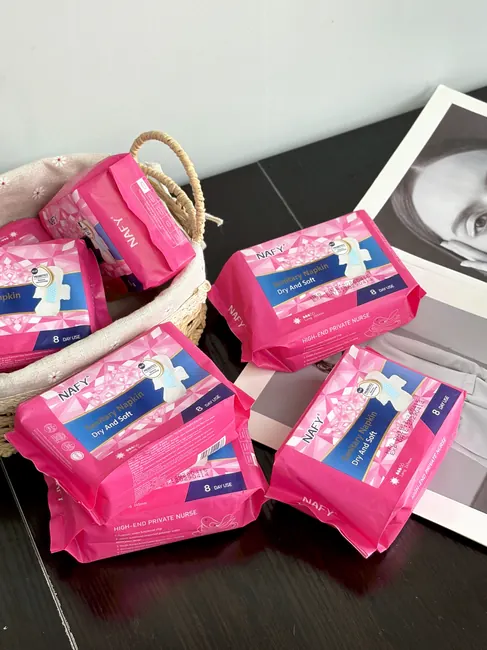
When a buyer opens a specification sheet, absorbency is the number at the top. In practice, three other decisions determine whether the product works.
A pad fails at the ends more often than in the middle. A core with capacity left can still transfer liquid at the edge, which the wearer experiences as a leak. Length is the first constraint, not the last.

Wings hold the pad flat against the underwear. Their position and depth decide whether the pad stays put through movement, and whether it releases cleanly when it is changed.

An individually wrapped pad costs more and travels better. A multi-pack without individual wraps is cheaper and worse to carry. The choice follows the channel, not the factory.
The absorbency number on a specification sheet is usually expressed in grams, measured under a standard test load. It is useful for comparing two pads of the same length and misleading for comparing two pads of different lengths. A 290 mm pad and a 245 mm pad can carry the same core recipe and produce very different real-world results, because the longer product has more surface area to spread the same volume across.
That is why we quote length first in a conversation and absorbency second. A buyer who says their market wants a higher absorbency figure is usually describing a complaint about leakage, and leakage on a correctly specified pad is more often a length or a wing problem than a core problem. Changing the core to fix it adds cost and does not solve the complaint.
The same logic applies to wings. A winged pad holds position better because the wings wrap around the underwear edge and prevent rotation. A wingless pad is cheaper to make and easier to wrap, and it works in markets where the product is changed frequently enough that movement is not the dominant failure mode. Choosing wings by price alone produces a product that shifts, which generates a complaint that looks like a quality issue.
Wrap style is the third decision and the one most often treated as an afterthought. An individually wrapped pad can be carried in a bag without contamination and opened with one hand. A pad in a multi-pack without individual wraps has to be taken from a pack that is already open, which is fine at home and awkward everywhere else. The wrap adds cost per piece and is the difference between a product a wearer will carry and one she will only use at home.
There is a fourth decision that rarely reaches a specification sheet: how the pad is folded inside the wrap. A pad folded once and sealed flat is thinner in the bag and opens without unfolding; a pad folded twice is more compact and takes longer to open. Neither is wrong, and the choice is usually made by whoever designs the wrap rather than by the buyer, which is why it is worth raising explicitly when a market has a strong preference.
The stock range is deliberately narrow so that a distributor can start with a carton. Everything else is produced to order against a confirmed specification.
Eight pieces per pack, 175 packs per carton, 1,400 pieces. Wings, individual PE wrap, wood pulp and SAP core.
→
Seven pieces per pack, same carton count. Wings, wider rear adhesive zone, individual PE wrap.
→Panty liners, longer night formats above 290 mm, wingless variants and non-standard pack counts are all produced to order. They are not held as stock because their specifications vary more between markets than the standard pads do.
A liner is a different product rather than a short pad. It carries a much lighter core, sometimes no SAP at all, and its job is to handle discharge rather than flow. A buyer who substitutes a short pad for a liner gets a product that is too thick, too expensive and wrong for the use case.

The gap between a day pad and a night pad is not simply length. The night format carries a wider adhesive zone at the rear, because the failure mode overnight is shifting rather than overflow. A wearer lying down puts different forces on the product than a wearer standing, and the adhesive pattern has to account for that.
Wing depth changes with length as well. A wing that is correctly sized for a 245 mm pad is too shallow on a 290 mm pad, which lets the longer product rotate at the edges. The wings are cut to the format rather than reused across formats, which is one of the reasons a new length carries a setup cost.
Pack count follows the market rather than the factory. A 245 mm pad at eight per pack and a 290 mm pad at seven per pack is a configuration that lands at a similar price point in most retail environments, which is why both are held as stock. A buyer who needs a different count can have it, and the count change is a packing change rather than a product change.
A pad is a stack of four functional layers. Each one can be specified up or down, and each one changes the product in a way a wearer notices.
Through-air-bonded nonwoven as standard. Perforated film, bamboo-fibre nonwoven and organic cotton are available through the OEM programme, each with a different hand and a different cost.
Wood pulp with superabsorbent polymer. Pulp spreads liquid across the core, SAP retains it under pressure. The ratio changes with format length so a longer pad does not simply carry more of the same mix.
A liquid-barrier film on the garment side. On a pad this layer is under less sustained load than on a pant, which allows a lighter film without a barrier risk.
Positioning adhesive on the garment side plus wing adhesive where wings are used. The pattern is the difference between a pad that stays flat and one that folds over on itself during wear.
The topsheet is where most of the perceived quality sits. A through-air-bonded nonwoven feels soft and stays soft under compression, which is why it is the default. A perforated film feels drier on first contact and can feel plasticky after an hour, and it is chosen when a market explicitly prefers that initial sensation. Bamboo-fibre and organic cotton are chosen for the material story rather than for a performance difference, and they cost more.
The core ratio is the specification most likely to be quietly changed by a competing supplier. Removing pulp reduces cost and reduces the core's ability to spread liquid laterally, which concentrates the load and makes the pad feel wet sooner. The absorbency figure can stay the same while the real-world experience gets worse, which is why a buyer comparing two quotes on grams alone is comparing the wrong thing.
Adhesive is the cheapest component and the one that generates the most complaints. Too little and the pad moves; too much and it tears the underwear on removal, which a wearer reads as a defect. The pattern is placed to hold the pad flat at the ends and along the wings without gripping fabric in the centre, where removal force concentrates.
The individual wrap deserves its own note because it is the component most often cut to reach a price. A PE film wrap costs a small amount per piece and protects the product from dust, from handling and from the adhesive picking up lint before use. A paper wrap costs less and tears unevenly, which produces a complaint about the pack rather than about the pad.
Wrap design also affects how the product is opened. A wrap with a tear notch at one end opens with one hand; a wrap with a sealed edge all round requires two. In a public bathroom that difference is the whole experience, and it costs nothing to specify correctly at the design stage.
Thickness is the specification buyers ask about after length and wings, and it interacts with both. Compressing a core to reduce thickness makes it stiffer, which changes how the pad conforms to the body. A thin pad that does not conform fails at the edges for the same reason a short pad does, which is why thickness is reduced by changing the core profile rather than by pressing harder during lamination.
The pad formats run at the Nafei plant in Shanwei, Guangdong, on dedicated pad lines rather than on the pant equipment. The site has produced feminine hygiene products since 1998.
Pads and pants share a material supply and a quality system but not a process. A pad line runs at a different speed, uses a different cutting arrangement and produces a flat product rather than a three-dimensional one. Keeping both under one roof means a buyer adding a pad line to an existing pant order deals with one supplier, one inspection standard and one set of export documents.
A pad is a flat product with few moving parts, which makes inspection straightforward and makes the checks that are skipped more conspicuous.
Quality management system covering production control, inspection and corrective action.
Environmental management system for the site, covering waste, effluent and energy.
Occupational health and safety management across the production floor.
Core weight and pulp-to-SAP ratio checked per batch, because a lighter core is invisible on the finished pad.
Packing list, commercial invoice and certificate of origin prepared in house per shipment.
Core weight is the check that catches the most common cost-down. A supplier asked to reduce price will often reduce pulp, which is invisible in a finished pad and measurable on a scale. Checking core weight per batch is how that stays under control rather than surfacing as a complaint six months later.
Wing adhesion is checked separately from body adhesion, because the two fail in different ways. A wing that releases too easily lets the pad rotate; a wing that grips too hard tears the underwear when the pad is removed. Both are tested against the same reference fabric so results are comparable across batches.
Retention samples are kept per run. On a flat product they are especially useful for settling disputes about thickness, since a pad that has been compressed in transit measures differently from one that has not, and a retained sample from the same batch shows which happened.
The same factory produces pads for markets that disagree about almost every specification detail. Three patterns repeat.
Where the winged day pad is the default, the product is judged on whether it stays in place. Buyers here want a wider wing and a stronger adhesive rather than a longer pad.
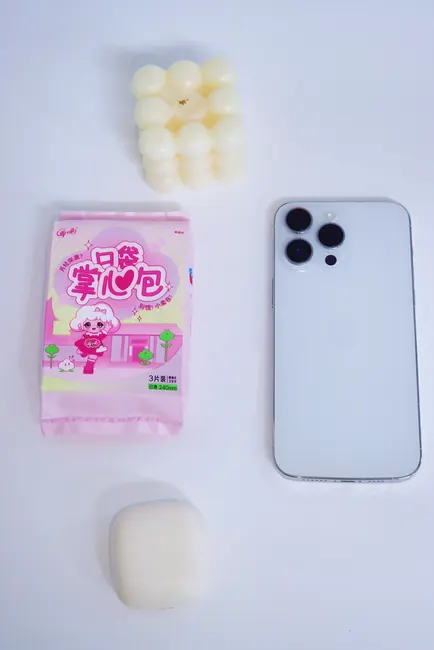
Where the product is changed several times a day, pack count and price per piece dominate. Longer formats sell less well because they are seen as unnecessary.
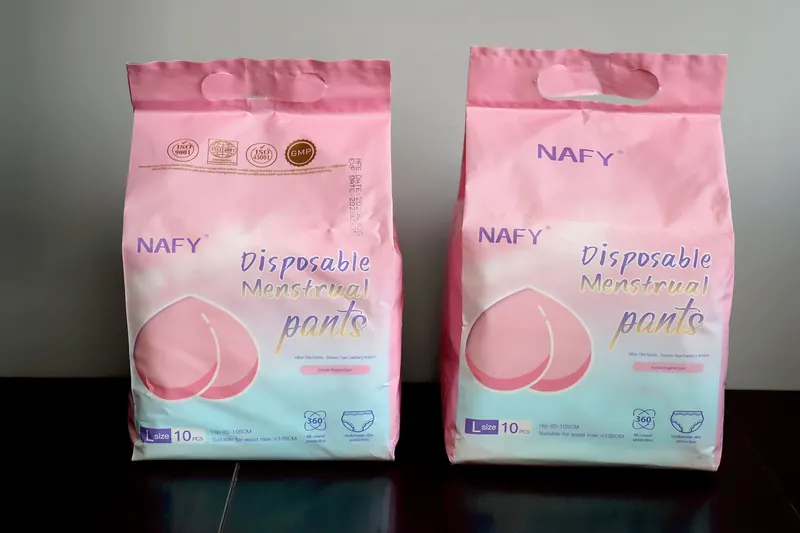
Where overnight protection is the purchase driver, the 290 mm format is the entry product and the day pad is the add-on. Pack counts skew toward fewer, longer pieces.
The wing-first pattern is common in urban markets where the wearer is active through the day and the pad has to survive movement. Buyers in these markets usually ask for a wider wing and a stronger adhesive before they ask for more absorbency, because their complaint data points at movement rather than at capacity.
Frequency markets behave almost inversely. Where the product is changed often, a longer pad is seen as an unnecessary cost and a larger pack is seen as a commitment. These buyers want a smaller pack at a lower price per pack, even when the price per piece is higher, because the purchase decision is made on the pack price rather than on the unit price.
Night-first markets treat the longest format as the primary product. A buyer there will stock a 290 mm pad as the main SKU and treat the day format as a secondary listing. Pack counts skew toward fewer pieces at a higher price, which changes the carton configuration and therefore the freight calculation.
None of these differences require a different factory. They require a different specification, a different pack and a different carton, all of which sit within the same production system. That is the practical advantage of buying pads from a factory that also runs private label: the format matrix already exists and a buyer is choosing from it rather than funding its development.
Six steps. On pads the specification is usually settled faster than on pants, and artwork is where the timeline is lost.
Length, wing or wingless, pack count, topsheet preference and target market. Length and wings settle most of the specification.
About two days. Samples ship from the intended materials rather than a laboratory approximation, so the hand and the fit are real.
Print-ready files checked against bag dimensions and local labelling rules. Most pad timelines are lost here rather than in production.
25 to 30 days after approval. Core weight and adhesive pattern are set per SKU and recorded against the batch.
Core weight, wing adhesion, seal integrity on the individual wrap, print registration and pack count.
Export documents prepared in house. Carton dimensions and weights provided so freight can be priced accurately.
The starter minimum for private label work is 10,000 pieces per size. On a pad that is roughly 1,250 packs at eight pieces per pack, which is a smaller commitment than the same piece count on a pant because the pack holds more units.
Changing length is the one specification change that carries a real setup cost, because it requires a cutting change on the line. Changing pack count, topsheet, wing depth or artwork does not. That distinction is worth knowing before a buyer negotiates, because a request for a non-standard length is a different kind of ask from a request for a different pack.
Artwork remains the most common source of delay. A bag that is missing a barcode or a net content statement cannot be printed, and reprinting is both slow and expensive. We ask for a complete artwork pack before scheduling, which is stricter than many buyers expect and cheaper for everyone in the end.
The questions that come up most often on pad formats, answered the same way we would answer them in a call.
Tell us the market, the channel and the complaint you are trying to solve. We will point at the format that addresses it rather than the one that is easiest to quote.