
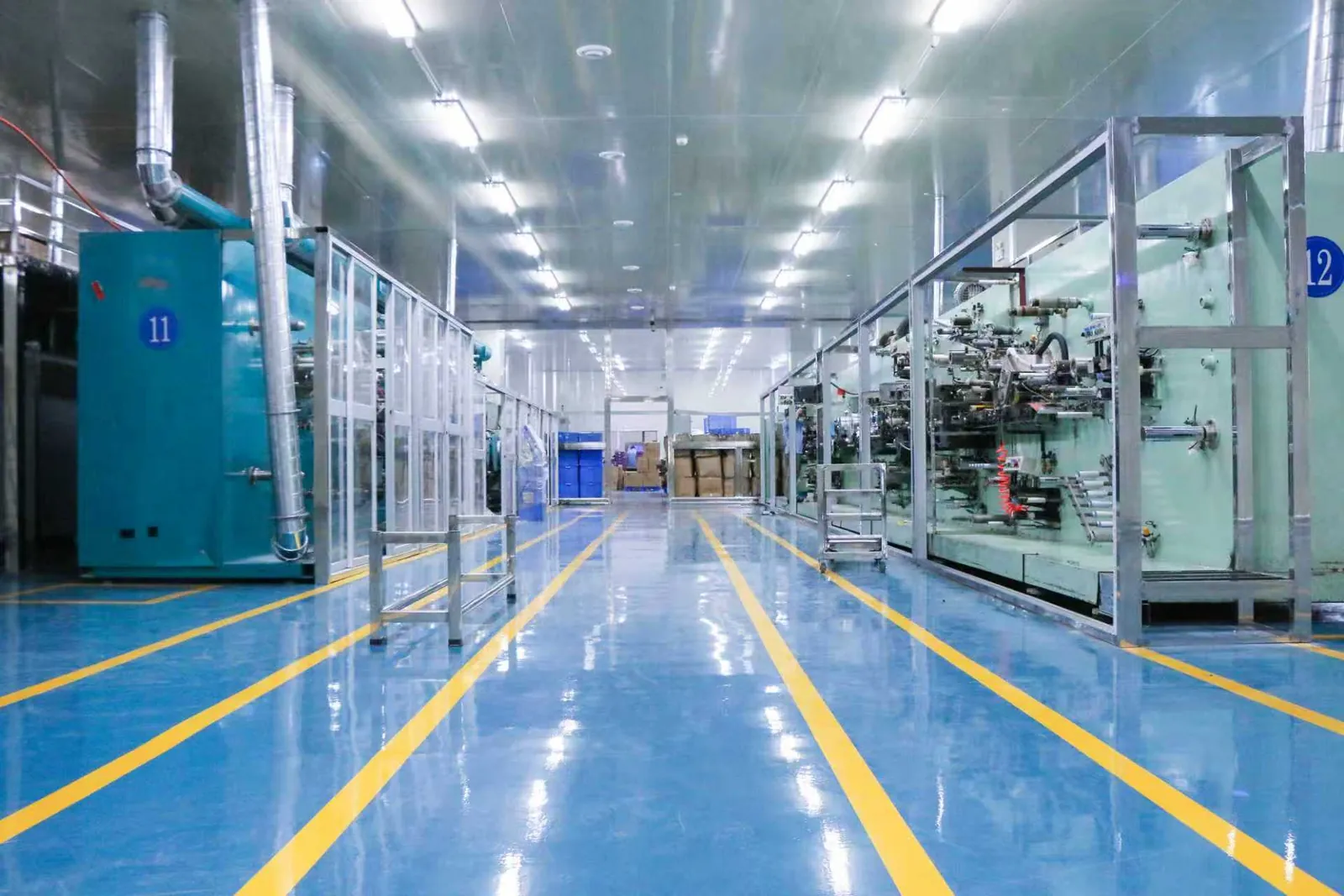
Ask for the manufacturing process behind disposable menstrual pants and you will usually receive a document about an absorbent core. That document is not wrong, but it describes the smaller half. On a pants machine the core arrives already made, wound on a roll or stacked in a magazine, while the machine stretches an elastic chassis, places the core on it, closes two side seams and seals a bag. Most specification arguments are really arguments about which half.
Where the Disposable Menstrual Pants Manufacturing Process Splits
A pad line is a former. Pulp is defibrated, blended with superabsorbent powder, drawn onto a rotating drum against a vacuum screen, and the layers are laid one after another in the machine direction before the composite is cut. One web, one beginning.
A pants line is an assembly. The chassis is a laminate of elastic material and nonwoven, bonded while held under tension. The core arrives as a finished sub-assembly. A glue applicator fixes it to the chassis, the leg opening is cut, the unit is folded, the side panels meet a welding horn, and the pants drop into a bagger.
Read the assembly half in the order the unit is actually built, because each step limits what the next one can correct:
- chassis laminate unwound and held under tension
- core placed and fixed with hot melt
- leg opening cut and cuff formed
- unit folded, then the side panels welded
- pants counted and sealed into printed film
So the disposable menstrual pants manufacturing process has two beginnings, and the two lines meet at a single glue joint. The sentence that hides this is that we make the core in house. Useful if true, but it answers a different question. What a buyer needs is the position of that joint, because it is the only place where a change on one side forces a change on the other.
The Core Is Formed on a Drum the Chassis Line Never Sees
Core formation happens against a screen: the drum sets the width, the profile and the density gradient, because the vacuum pulls the fibre and powder mix into a fixed cavity. Change the core width and you change tooling on that drum, not a setting on the assembly line.
That is why core units are commonly made to a small number of stock widths and cut to the format of the moment. The assembly line can run a different chassis size without touching the drum. One continuous web would let the slower half set the pace and stop the drum at every change.
The practical consequence is a document question. When a supplier quotes a core width and a core length, the figures describe an intermediate good that exists for a few minutes before it becomes part of a pants. What survives into the finished unit is the menstrual pants absorbent layer structure: the order of the layers, where the superabsorbent sits, and whether the top layer is designed to pass liquid down or to hold it back.
The Chassis Dimension You Quote Is a Relaxed Dimension
The waist of a pull-up is not a strip of elastic sewn into a band. The sanitary pants elastic waistband material is usually part of the chassis laminate itself: elastic film or elastic strands bonded between nonwoven layers while the whole web is stretched.
Because the bond is made in the stretched state, the dimension only appears after the material relaxes. Recovery depends on time and drifts with temperature, so a waist measured at the end of the line and the same waist measured a day later in a carton are two measurements of one unit.
A line that says only waist is therefore not measurable. It has to state whether the figure is relaxed or stretched, how long the unit rested before measuring, and where the tape was placed. Without those three, a buyer and a factory can both be honest and still disagree, and the argument becomes about the number rather than the method.
The Side Seam Is a Weld Pattern With No Thread in It
Pull-up pants are closed by bonding the front and back side panels, in most constructions an ultrasonic weld: a horn presses the laminate against a patterned anvil and the material melts only where the pattern touches. There is no thread in that joint, so no stitch density to inspect.
The joint is a set of bonded points, and its failure starts at the edge of the pattern. That makes the failure mode more informative than the strength figure. A seam that tears through the film, a seam that peels between laminate layers and a seam that releases at the pattern edge are three different problems, and only the last one is a welding setting.
Ask for the test to be written as a grab pull across the pattern, at a stated rate, with the failure mode recorded next to the result. A figure without the failure mode cannot be compared with another supplier's figure, because the two may have measured different events.
Core Attachment Is a Glue Pattern, and the Cuff Belongs to the Chassis
The core is held in place by hot melt applied in a pattern, whether spiral spray, slot coating or a set of beads. That pattern decides two things which rarely appear in a specification: how far the unit can flex before the core shifts, and whether the adhesive reaches the leg opening.
Leg containment is often credited to the absorbent layer, but the cuff and its elastic sit on the chassis. Liquid that escapes at the leg has frequently travelled along the top layer rather than through the core. That is an assembly problem, and no change to the layer structure will settle it.
This is also why a factory that builds both halves under one roof can close a complaint faster than one that buys cores in. The two candidate causes sit on two machines an engineer can walk between in a minute.
So the Specification Describes Only the Measurable Half
There is a reason a sanitary pad OEM technical specification sheet runs long on the core and short on the chassis. Incoming material can be measured: weight per area, powder load, fibre ratio, thickness under a stated pressure. Those figures fit a table and can be checked against a delivery.
Chassis properties are format dependent and mostly destructive to test. A weld cannot be checked without pulling a unit apart. Recovery cannot be checked without waiting. So those properties end up as prose, or as nothing, and the table ends up describing whatever was easiest to count.
The shape of the document reflects what is measurable, not what decides whether the product works. A buyer who accepts that shape is buying the core and hoping for the chassis, across two lines that were never described together.
What to Write Instead of a Single Value
The fix is not more numbers. It is fewer numbers with conditions attached, plus the failure mode written beside them. A line a factory cannot answer with a figure is still a useful line, because it forces a method into the conversation.
| Property | What a bare figure leaves out | The line that makes it checkable |
|---|---|---|
| Core retention | Which liquid, which load, how many times it was given | Retention after a stated count of insults, under a stated load, sampled at a stated position |
| Waist | Whether it was relaxed or stretched, and how long it rested | Relaxed circumference after a stated rest period, tape placed at a stated point |
| Side seam | Which event happened first when it failed | Grab pull across the pattern at a stated rate, failure mode recorded |
| Glue pattern | Whether the adhesive reached the cuff at all | Pattern position relative to the cuff, checked on a cut unit |
Three of those four lines can be answered in writing within a day by a factory that runs the process itself. The fourth, the glue pattern, needs a cut sample, which is why a first sample is worth more opened than photographed. Buyers still choosing a format often find the minimum order question settles it first.
Walk the Process Backwards From What Cannot Be Undone
An audit of the disposable menstrual pants manufacturing process usually follows the material: fibre in, core out, chassis in, pants out, carton sealed. That order is good for understanding and poor for setting priorities, because the cost of a mistake rises as the unit moves downstream.
A core that is out of tolerance can be scrapped at small cost. A printed film carrying the wrong market language cannot be un-printed. A welded side seam opened for inspection cannot be reclosed to the same condition. So the conversation should begin at the end and walk backwards, asking what leaves the building in a state nobody can repair.
Date code and market language come first, because they are printed. Seam and bag seal come next, because they are closed. Layer structure comes last, not because it is unimportant, but because it is the one part that can still be corrected before the unit is sealed.
Send the layer list and the chassis drawing you are working from, and I will mark which lines in the disposable menstrual pants manufacturing process can be answered with a figure and which ones need a method.
That is a shorter conversation than a full review, and it usually settles the first sample before it is built. The contact page reaches the team that works on pants formats.
Frequently Asked Questions
Why is the core made on a separate line from the chassis?
Because the two halves need different conditions. Core formation depends on a vacuum drum that fixes the width, while the chassis needs the laminate held under tension while it is bonded. Running both as one web would make the slower half set the pace.
Should a waist measurement be taken stretched or relaxed?
Take it relaxed, and write down the rest period before measuring. The chassis is bonded while stretched, so the dimension only settles after recovery, and recovery keeps changing with time and temperature. A stretched figure and a relaxed figure describe different states.
How is the side seam checked on pull-up pants?
With a grab pull across the weld pattern at a stated rate, and with the failure mode recorded beside the result. A seam can tear through the film, peel between laminate layers or release at the pattern edge, and those events point to different causes on the machine.
Does the absorbent layer decide whether pants leak at the leg?
Not on its own. The cuff and its elastic sit on the chassis, and liquid can travel along the top layer and escape at the opening without passing through the core. Before changing the layer structure, check the glue pattern and the cuff on a cut unit.
What belongs in a technical sheet for pants?
A layer list with weights, core dimensions with a sampling position, a relaxed waist with a rest period, a seam test with a failure mode, and the glue pattern against the cuff. Each line should name its condition, because a value alone cannot be checked.