
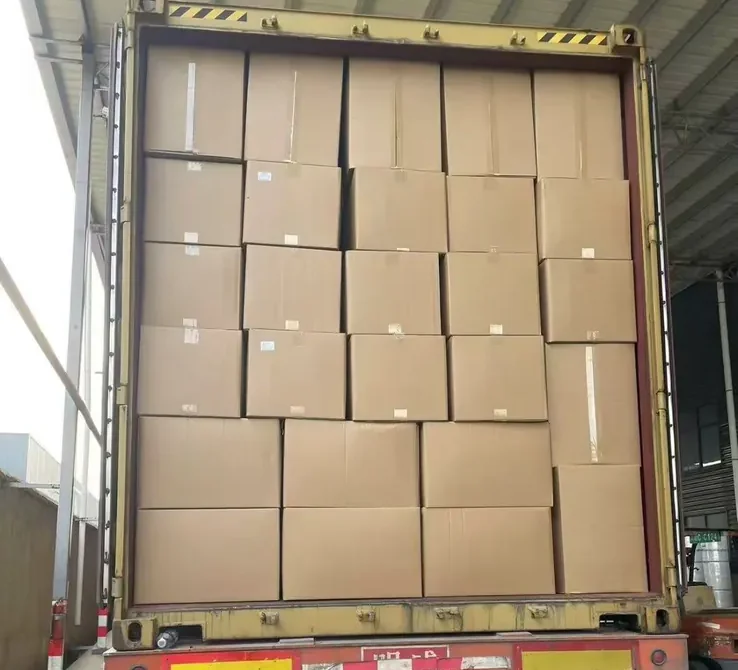
A carton of panty liners almost never runs out of weight. It runs out of space. Load a container to its permitted mass with liners and you will still have room left over, which means the freight you pay is mostly the air sealed inside the bags and the corrugated around them. That single fact reorganises every decision that follows: carton size, pallet pattern, booking date, and what the bag looks like when the doors open.
Panty Liners Sea Freight Is Billed on Occupied Space
Carriers price a container two ways: by mass, or by cubic measure, whichever yields more revenue. For dense cargo the mass decides. For liners the measure decides, and it decides by a wide margin, because the product is mostly air held in shape by film and fluff. This is why panty liners sea freight behaves like a packaging problem wearing a transport label. Shrink the carton and you buy fewer containers for the same order. Shrink the pad and you buy nothing at all.
Why the Carton Cubes Out Before the Weight Does
A carton dimension is not drawn freehand. It is the bag width, the bag thickness under compression, the number of bags stacked, plus board on two sides. Change one input and the carton does not adjust a little; it jumps to the next whole configuration, and the pallet pattern usually has to be rebuilt with it. That is why carton conversations stall so often: the useful levers sit upstream, in bag count per carton and film thickness at packing, and those collide with minimum order quantity almost immediately.
| What the buyer asks for | What actually sets it | Where the difference lands |
|---|---|---|
| A smaller carton | Bag count and film thickness at packing | A new carton drawing and a new pallet pattern |
| A lower freight rate | Cubic measure occupied, not mass | Fewer cartons per container, or a different container |
| A firmer carton | Board grade and time under load at sea | Cost moves out of freight and into packaging |
Incoterms for Panty Liners Decide Who Owns the Water Leg
Trade terms do two separate jobs and buyers routinely collapse them into one. They fix where cost passes, and they fix where risk passes, and those two lines can sit in different places. Under a term where the seller arranges carriage, the seller pays the ocean leg while the buyer may already carry the risk from the moment the container is on board. The consequence is practical rather than legal: whoever holds the claim had to be able to inspect, and after the doors are sealed nobody can. So Incoterms for panty liners are better chosen by asking who can act if the cartons arrive soft.
The Booking Date Fixes the Panty Liners Delivery Schedule
Finishing production early does not move a sailing. Three things move it: a confirmed booking, a space allocation, and a container returned to the terminal before cut-off. All three belong to whoever holds the booking, and on most liner orders that is the buyer or the buyer's forwarder. A panty liners delivery schedule therefore carries two dates that people treat as one. The day the goods are ready to load is a factory date. The day the carrier stops accepting them is a booking date, and no factory can promise it on someone else's behalf.
What Compression Does to a Bag During the Sea Leg
Cartons at the bottom of a stack carry the mass of everything above them for the whole voyage, and corrugated board does not resist a sustained load the way it resists a brief one. Under constant compression the board creeps, the stack settles, and the load transfers inward to whatever is holding the shape. For a bag of panty liners that is air. The film stretches, the air migrates toward the open end, and the printed panel takes a set. When the doors open, the carton reads shorter than the drawing and the bag reads fuller at one end.
Recovery after unloading is partial, and it is uneven, because the deformation is not uniform. A bag that spent the voyage in the bottom tier does not return to the shape it had at packing, and resting does not flatten a crease in the printed face. This is the trade a shipper is actually making when the carton is made tighter: cubic metres saved at booking are paid back in bag appearance at the shelf. Neither side of that trade is dishonest. Deciding one side without measuring the other is where orders go wrong.
Condensation Rides Along as a Second Cargo
A steel container crossing climate zones does not hold one temperature. It warms by day and cools at night, and each cooling cycle pushes moisture out of the air onto the coldest surface, which is the roof. Water then drips onto the top tier. The moisture has to come from somewhere, and it comes from pallet wood, from the board itself, and from the air sealed in at loading. That is why a carton which left dry can arrive with a soft top and a stained panel, and why the damage clusters in the upper layer instead of spreading evenly.
Board loses compression strength as moisture rises, so a carton that was adequate at loading becomes marginal after a wet voyage. Desiccant absorbs part of the problem, but it is a buffer and not a correction; how much is needed depends on how much water went in at the door, which is the point we record under quality control rather than at the packing station.
Panty Liners Container Shipment: Where the Stack Fails
In a mixed container the heavy pallets go low and the light ones go high. That is correct for stability and wrong for liners, because a liner carton is the most compressible object in the load. High in the stack it rides well. Pushed against the door as void fill it carries whatever shifts forward. The failure we see is rarely a crushed pad; it is a deformed carton at the door end, where nothing behind it takes the strain and the lashing pulls in tension instead of compression.
- Which board grade may sit in the bottom tier, and which may not.
- Whether liner cartons may serve as void fill against the door.
- What the lashing bears against, pallet or board.
None of those lines cost anything at the packing station, and all of them change what the receiver opens. They belong in the loading instruction, not in a conversation on the day.
Which Half of the Schedule a Factory Can Really Control
We load out of Shanwei and have done since 1998, and one habit has saved more disputes than any shipping estimate: naming the boundary early. We ship from China and do not hold stock locally, so the dates we can be held to are the ones inside our own gate, goods ready for loading and container sealed. Everything after that belongs to the carrier and to whoever booked it. Buyers who accept that split plan backwards from the cut-off; buyers who do not tend to discover it at the terminal.
If you want the figures that would actually move your panty liners sea freight bill, send the carton drawing you use now, with the bag count and pallet pattern. We will return the loading arrangement we would use and mark where it differs. If the carton is still open, custom packaging is the better place to start, and contact reaches the desk that answers it.
Frequently Asked Questions
Does panty liner cargo usually reach the container weight limit?
Rarely. Liners are light for the volume they occupy, so a container fills in cubic measure long before it approaches its permitted mass. The binding limit is the space the cartons take, which is set by carton size and pallet pattern rather than by the product inside.
Who books the container when the term is FOB?
The buyer or the buyer's forwarder books it, and therefore controls the cut-off date. A factory can confirm that goods are ready to load. It cannot confirm a sailing it did not book, and treating those two confirmations as one is the most common source of schedule disputes.
Why do liner cartons arrive shorter than the drawing?
Corrugated board creeps under sustained load. Over a long sea leg the bottom tier compresses, the stack settles, and the board does not spring back fully. The carton is not defective. It has been held at the top of its working range for far longer than a road trip would demand.
Should liner cartons be used as void fill at the door end?
No. Liner cartons are the weakest object in the load and the door end is where shifting cargo concentrates force. Keep them high in the stack or against a bulkhead, and fill the door end with something that does not deform, or with dunnage that does.
What should a buyer request before confirming a booking?
Ask for the carton drawing, the bag count per carton, the pallet pattern, and the loading conditions recorded on the day. Those four explain most arrival surprises better than a transit estimate, because they describe what was actually sealed behind the doors.


