
A pant quote and a pad quote can carry the same unit figure and still describe two different factories. The pad is priced around a core, with a film sheet stuck underneath it. The pant is priced around a length of laminated material that gets cut, gathered and closed into a garment. Ask three suppliers for a disposable period pants FOB price and the spread between them is rarely the raw material. It is how much of each metre turns into a pant.
Why a pant is priced per metre rather than per gram
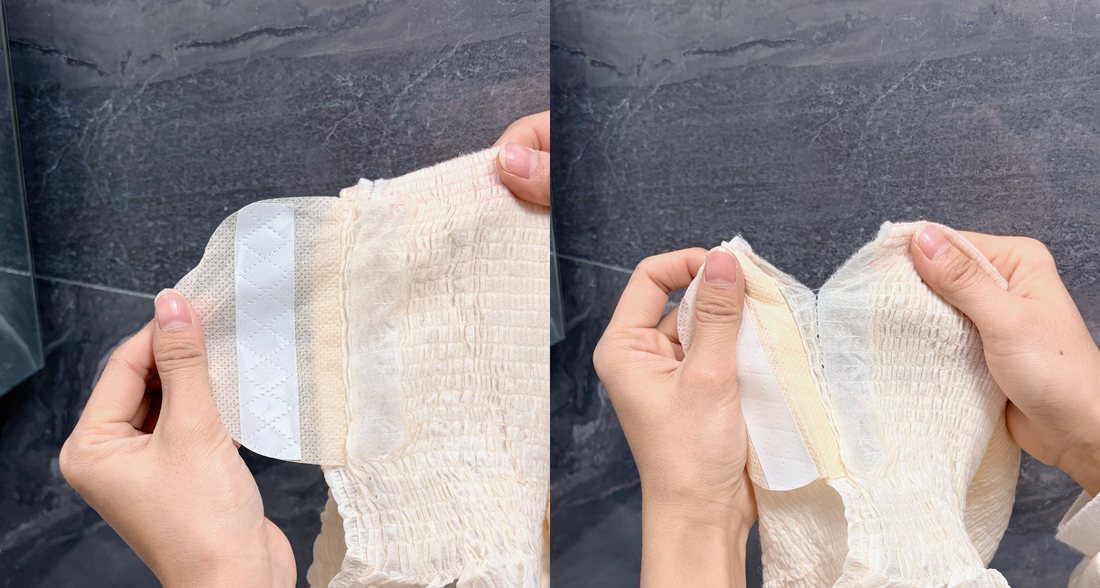
On a pad, the film is a rectangle beneath the core. On a pant, the same film runs from the front waist, under the crotch and up the back, and the side seams close it into a shape. The core sits inside that shell instead of carrying it.
The effect on price is easy to miss. The absorbent core is a modest share of what a pant is made of, so a cheaper core barely moves the total, while the area of film and nonwoven moves it at once. You can test the claim with a tape measure before opening a bag: lay a pant flat, measure across the hip and from waist to waist over the crotch.
That area, not the absorbency wording, is what the sheet is really about. Our pants manufacturing process is organised around the laminate and the waist, because that is where the cost actually sits.
Where the disposable period pants FOB price comes from
A pants sheet is assembled from the bottom up. Laminate is priced by the metre, elastic is priced by the metre, film and bags are priced by the thousand. Then the totals are divided by the pants a metre yields and by the pieces a bag holds.
Each of those divisions carries an assumption the buyer never sees. That is why the disposable period pants FOB price behaves like a derived figure rather than a quoted one. When two sheets differ, the useful question is which division differs, not which supplier is cheaper.
A supplier who looks low on material and high on the divisor is telling you something specific about their cutting layout, and it is worth asking about it before you argue over the total.
The leg opening is the only part of a pant you throw away
Everything else in a pant ends up worn. The leg curve is cut out and leaves the line as trim, and that trim was bought at the same metre price as the product around it. This is the widest single gap between two offers for a pant that looks identical on paper.
Cutting layouts are drawn to nest. Alternating pants end to end lets one leg curve share the waste of its neighbour, so a layout that nests well yields more pants from the same web. Two factories running the same pant can therefore quote differently without either of them being wrong. The size guide shows where a width change lands.
It also explains why a small change in shape is never a small change in price. A different pant width or leg curve is a different die, and a die is drawn once, cut once and paid for once.
Elastic arrives by the metre and leaves as a gathered waist
Waist elastic is not a trim item added afterwards. It is fed under tension, bonded while stretched, then released once the seam closes, and that release is what gathers the waist. Because it is bought as a band of a given width by the linear metre, a wider waistband costs more in two directions at once.
Tension is a machine setting, not a material line on a specification. That matters when comparing offers: a looser gather reads as a flatter waist, and it appears nowhere in a price sheet or an absorbency figure. It appears in the hand, on the shelf, after the pallet is opened.
What a disposable period pants unit price leaves out
Three things sit outside the figure and inside the invoice: how many pieces a bag holds, how much material the seal consumes, and how much trim the layout assumes. The disposable period pants unit price is a division result, so it inherits all three without naming them.
This is why fill count is worth settling before price. Change the count and the bag changes size, the carton follows, and the piece figure moves although nothing about the pant did. Buyers who fix the count first and the price second end up with sheets they can compare. Our MOQ page covers the same point from the volume side.
A disposable period pants price list follows the same logic. It prints one line per pack and leaves the per-pant value to be calculated, because the pack is what ships and what a purchase order names.
Why two product names quote at the same rate
Ask for a disposable menstrual pants FOB price and you will usually receive the same sheet as a period pants request. The goods are the same goods, and the cost base does not change because the trade name did. What changes is bag artwork and label text, which sit on a separate line.
We export under the disposable menstrual pants name, produce in China and ship from China, with no inventory held in the destination market. A buyer who needs the same product under a local retail name should expect the artwork to appear in the sheet, and little else to move.
Cheaper usually means thinner film or a looser gather
When one offer lands below the rest for a pant of the same construction, the gap sits in one of two places. Either the film is thinner, which you feel as crinkle and see as a stiffer drape, or the gathers are looser, which you feel as a waistband that will not sit flat. Neither one shows up in an absorbency test.
So the question worth putting in writing is not why the offer is lower. It is which film gauge and which elongation setting the offer assumes. A supplier who answers that in a line has a cost model behind the number, and one who answers with adjectives has a price.
How to compare two pants quotes in one afternoon
The table below is the order I would use, moving from what you can check yourself to what only the supplier can confirm.
| What to ask | Where the answer shows | What it changes |
|---|---|---|
| Flat width and length of the pant | Tape measure on one sample | Film area, the widest material line |
| Pieces per bag and per carton | Pack column of the price list | The divisor, and therefore the unit figure |
| Cutting layout and trim assumption | Supplier cost sheet, in writing | Pants per metre of laminate |
| Film gauge and elastic width | Material specification | Hand feel, and the base of the offer |
| Elongation setting at the waist | Machine setting record | Gather depth, invisible on a spec sheet |
A pair of offers that survives all five rows is comparable. A pair that survives two of them is a conversation about price rather than a comparison of goods. If you want the rows filled in for a specific pant, the manufacturer page sets out what we confirm in writing before an order, and the export desk will answer a specification question directly. We have made feminine hygiene products since 1998, and we still quote a pant as a division rather than a figure.
Frequently Asked Questions
What does a disposable period pants FOB price include?
It covers the packed pant delivered to the named port, and it normally absorbs the bag and the carton. What it does not cover is ocean freight after that port, import duty, or any handling at your end of the route.
Why is the per-pant figure missing from most price lists?
Because the pack is the unit that ships and the unit a purchase order names, so the list follows the pack. Dividing the pack figure by the fill count gives the per-pant value, and the fill count is the assumption to confirm in writing.
Can a lower offer really come from a thinner film?
Yes, and it is one of the two usual sources of a gap. A thinner film lowers the material line and changes how the pant feels in the hand. Ask for the gauge in writing rather than judging from the position of the offer on the page.
Do you keep inventory in the destination market?
No. We produce in China and ship from China, and we keep no inventory in the country of sale. Every order is built against a confirmed pack and quantity before production, which also means fill count is fixed early.
How many offers do I need before comparing them?
Two is enough, provided both sheets state the pant size, the pieces per bag, the film gauge and the cutting assumption. Without those four, the figures describe different products and the comparison is about a decimal place.