
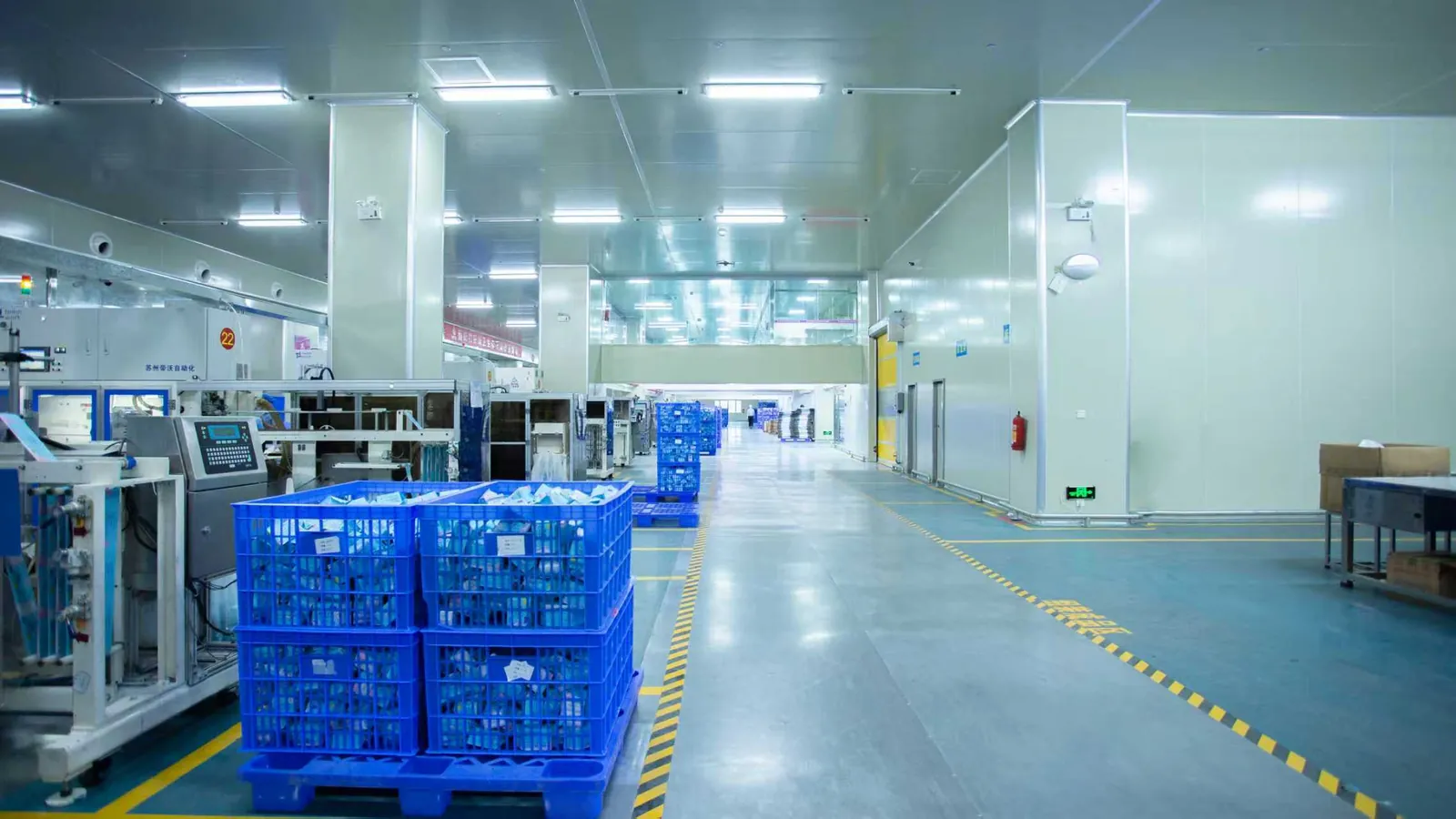
The file most buyers approve is a photograph of a bag with their artwork mapped onto it. Nothing in that image can drift out of register, nothing in it is welded shut, and none of it was printed on the film being bought. The approval therefore covers a picture. The package itself is decided in two places that a rendering cannot reach: the seal zone, and the register between print and weld.
Two Different Objects Share the Name Mockup
In a converting plant the word covers two things that are not interchangeable. A soft proof is a rendering: your artwork wrapped onto a photographed bag and lit until it looks plausible. A pre-production sample is a real bag, formed on the real former from the real plate, filled, and sealed on the jaws that will run your order. One is a conversation about layout. The other is a physical argument about film.
They fail differently. A rendering fails by being flattering, because a screen has no register error and no seam. A physical sample fails honestly: the weld is thinner than the picture implied, the print sits closer to the seam than the file said, and the white behind the artwork reads grey next to a white pad.
When a buyer says the mockup looked right, the useful follow-up is which of the two they were shown, and on what substrate. A supplier of a private label sanitary pad packaging mockup should be able to answer that in one sentence, because the answer decides whether the file has ever been tested against a machine. Anyone quoting private label work without that sentence is quoting a designer, not a plant.
The Dieline Comes From the Die, Not From Design
A dieline is not a creative document. It is a measured drawing of the flat shape a pouch takes when a specific machine cuts, folds and seals it. The former sets the flat width and the gusset, the jaws set where the weld lands, and the fill tube sets how much of the face is left for print. Change the machine and the outline changes with it, which is why the drawing is a machine document and not a brand asset.
Designers who draw their own outline usually produce something elegant and unbuildable, and the reason is nearly always the same: they treat the seal allowance as margin. It is not margin. It is the strip of film the jaws must grip, and on many structures it has to stay free of ink for the joint to form properly. Whoever prints and forms the bag is the only party who can measure it, which is the practical argument for keeping forming and printing in the same building as the pad line.
That fixes the order of work. Die number first, then dieline, then artwork, then plate. Teams that start from the artwork spend the next revision deleting elements they had already fallen in love with, and the printer spends that revision explaining why.
What a Private Label Sanitary Pad Packaging Mockup Cannot Show
Four properties of the finished package stay invisible in every rendering, at any resolution, on any screen. Each one of them is already fixed before the file leaves the design tool.
- Whether the weld lands where the artwork assumed it would.
- Which side of the film carries the ink, and what white sits behind it.
- How far the repeat can drift across a full roll before the graphic meets the seam.
- Whether the colour approved on screen exists as an ink on that substrate.
A rendering is not wrong about these things. It is silent, which is worse, because silence reads as approval.
Ink Inside the Seal Zone Turns a Weld Into a Weak Joint
Heat sealing joins a sealant layer to itself under pressure and temperature. Ink is not a sealant. Where ink sits inside the weld area it becomes part of the joint, and the joint stops being film and becomes printed layer, which is the least cooperative material in the stack.
This is why the full-bleed look that wins on screen is the costly one on film. It asks the converter to hold an unprinted strip at exactly the jaw width while the printed image wanders above and below it, so the artwork must carry a quiet band the design never displays. A plate set also has its own minimum, separate from the pad order quantity, which is why the beautiful edge-to-edge version is usually the version that forces a bigger run than the buyer planned.
Seal strength is checked destructively. The specimen is pulled until the joint separates, so the reading describes a sample and never the seam that shipped. That is an argument for building margin into the file rather than for asking for a larger sample.
Print Register Decides Where Your Artwork Ends Up
Flexible packaging is printed as a repeating image on a continuous web, then formed and sealed at a fixed point downstream. Two clocks run at once: the print repeat pitch, which moves with tension and film stretch, and the jaw position, which does not move. Flexible packaging print register is a control loop chasing that difference, not a fixed offset that can be dialled in once and forgotten.
So the honest question is not where the artwork landed on the approved sample. It is how far it can wander before the graphic reaches the weld. Files with a generous quiet margin survive a normal run; files that bleed into the seam convert every registration correction into a defect.
This is the part of sanitary pad packaging artwork requirements that gets skipped most often, because it cannot be seen until a roll exists and the money is already spent.
Surface Print and Reverse Print Are the Same Picture
On clear or white film there are two ways to carry an image. Print it on the outside, or print it in mirror on the inside and laminate over it. Both produce an identical rendering. They do not produce the same package: reverse printing traps the ink under the sealant layer, needs a white backing plate for colour to read, and requires a plate set built backwards.
Buyers usually learn which one they bought in one of two moments: when the pouch scuffs against a carton and the image goes with it, or when the white they approved reads grey beside the product. Neither moment happens on a screen.
Revision Control Is a Letter on Four Documents
An artwork change after a plate exists is not an edit. It is a new plate, a new proof and a new approval, in that order, and the only thing keeping the sequence honest is a revision letter that appears identically on the die drawing, the artwork file, the plate and the approval sheet.
When those four disagree, the printer builds from the plate, the buyer trusts the file, and the gap ships. Nothing in that failure is dramatic. It is one letter out of date.
Write the sanitary pad packaging artwork requirements as a numbered list with the revision letter at the top, and keep every approval attached to that letter rather than to a date. A date tells you when someone looked. A letter tells you what they were looking at.
What to Ask For Before Any Approval Is Signed
Five requests, in this order, turn a mockup conversation into something a plant can actually build against.
- The die number, and a dieline drawn by whoever owns the machine.
- A packaging artwork proof printed on the substrate you are buying, not on paper.
- Whether the ink is surface or reverse, stated on the approval sheet.
- The revision letter, repeated on all four documents.
- The name of whoever holds the editable artwork file.
The last item is commercial rather than technical, and it is the one buyers forget. If the editable file lives with a designer you no longer work with, your next change waits on them and not on the printer. Ownership of a flattened proof is not ownership of a package, a point the wholesale buying guide makes in the same order for the commercial side of a first order.
None of this makes a private label sanitary pad packaging mockup useless. It makes it a document about layout, which is exactly what a picture can be trusted for.
Send the private label sanitary pad packaging mockup you are about to sign, together with the die number and the film structure written on it, and we will mark the four places where that file and that film will disagree before a plate is paid for. If the die number is unknown, say so, because that is the first thing to settle. Send the file and the die number here.
Frequently Asked Questions
Is a rendered mockup enough to approve packaging?
No. A rendering shows layout, and layout is the only thing it can be trusted for. It cannot show registration, the seal area, the side the ink sits on, or how the colour behaves on your substrate. Approve layout on screen if you like, but approve the package only against a sample printed on the film you are buying.
Who should draw the dieline for a private label pouch?
The party that owns the machine. A dieline is a measurement of how a specific former, jaw set and fill tube handle a specific film, so it belongs with the converter. A designer can lay artwork on top of it, but an outline invented in a design tool usually breaks at the seal allowance.
Why must the seal area stay free of ink?
Heat sealing joins a sealant layer to itself. Ink inside that band becomes part of the joint, and the joint becomes the weakest layer in the seam. Keeping a clean strip also gives registration room to drift, so the graphic does not reach the weld when the print repeat moves.
Can the same artwork run on paper and on film?
It can be reused as a layout, not as a file. Paper takes ink differently, folds differently and has no sealant layer, so the dieline, the colour build and the seal allowance all change. Treat a carton proof as a design reference and rebuild the file on the film dieline before approving anything.
What belongs on a packaging approval sheet?
The revision letter, the die number, the substrate, whether the ink is surface or reverse, and the name of whoever holds the editable file. Those five lines are what a printer builds from and what a buyer can point at later. A signature without them approves a picture, not a specification.


