
Why the 'Softest Topsheet' Usually Traps More Humidity
2026-08-05
Last quarter a buyer asked me for "the softest topsheet you've got" on a new private-label pad. Straightforward request. We shipped the sample. Two weeks later the feedback came back: the skin contact felt sticky after a couple of hours. Not what either of us wanted.
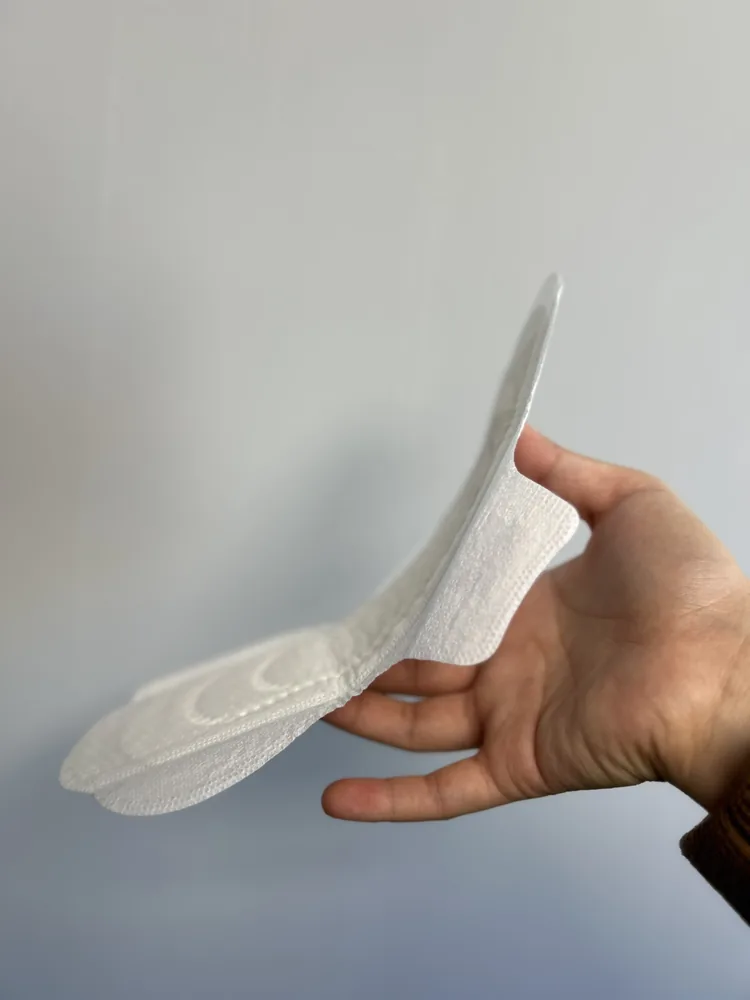
We traced it. The culprit wasn't the softness. It was the denier — how thick each fiber in that topsheet is. And it's one of the most misunderstood specs I deal with.
Denier, in plain words
Denier is just fiber thickness. A fine-denier sheet feels softer in your hand. A coarse-denier sheet feels a little more substantial. Showroom buyers almost always point at the fine one.
Here's the part that trips people up: finer fibers pack tighter, so the gaps between them get smaller. Coarse fibers leave bigger voids. And bigger voids mean liquid drains through faster instead of sitting on the surface your customer's skin touches.
One of the old hands in our material network puts it bluntly: coarser fiber leaves gaps about twice as large going from 1 to 2 denier, and the liquid drops through roughly twice as fast. From 2 to 3 denier, the gap roughly triples. The numbers aren't magic — they're just geometry. But they reverse what most buyers assume.
Why everyone chases "soft" anyway
Because soft is what you feel when you pick the sample up. Humidity is what the body feels three hours later, and nobody's hand is on the line for that.
"Soft is just handfeel. The hand touches it, not the body." That's the line I keep repeating to buyers. The body cares about damp and clammy, not fluffy.
A topsheet's real job is the opposite of a towel. You don't want it to hold liquid at the surface. You want it weak-absorbing and high-bulk, so fluid punches straight through to the layer below and the skin side stays dry. Hot-air nonwoven does this well even though it's synthetic — it's the bulk and the finish that matter, not the "natural" label.
What to actually specify
Next time you brief a factory, don't write "softest topsheet." Write the things that decide comfort:
- a topsheet that wicks fast and holds little at the surface,
- a stated denier and basis weight, not just "soft,"
- a rewet / reflow test result — not a handfeel sign-off.
If your supplier can only talk about touch, push for the test data. The layer right beneath the topsheet matters just as much, so treat the two as one spec, not separate line items.
At our OEM line we'll usually walk a buyer through the full stack before locking a topsheet, because picking denier alone is how you end up with a pad that feels great in the hand and annoying on the body. If you want to see how we control materials end to end, the factory capability page lays out the bench we run.
FAQ
What denier is "best" for a sanitary pad topsheet?
There isn't a single best number. It's a trade-off against basis weight, finish, and the core below it. We decide denier as part of the whole structure, not in isolation — which is exactly why "make it soft" is a weak brief.
Does coarse denier feel rough on skin?
Not if it's finished right. Bulk and surface treatment do more for skin feel than the denier digit does. A well-made coarse sheet is perfectly comfortable.
Should I ask for cotton or synthetic topsheet?
Separate question, and "cotton" isn't automatically the safe pick — a pure-cotton towel is about as far from a good topsheet as you can get. Judge by performance specs, not the fiber's reputation.
How do I test topsheet performance before a bulk order?
Request rewet and reflow test data, plus a side-by-side wet-back comparison against your current product. Skip the handfeel-only approval — it won't predict the three-hour experience.
Turn this guide into an OEM brief
Share your product direction, target market, packaging idea and sample questions. Nafei can help translate the buying guide into a practical RFQ discussion.
- Product type: period pants, sanitary pads or mixed OEM project
- Target country, channel and buyer positioning
- Size range, material preference and sample review focus
- Private label artwork, pack count and estimated quantity