
The 5-Second Pinch Test That Tells You If a Pad Will Leak
2026-08-05
You can't run a full lab on every sample that lands on your desk. But there's a check our engineers do in about five seconds, and it catches problems a spec sheet hides.
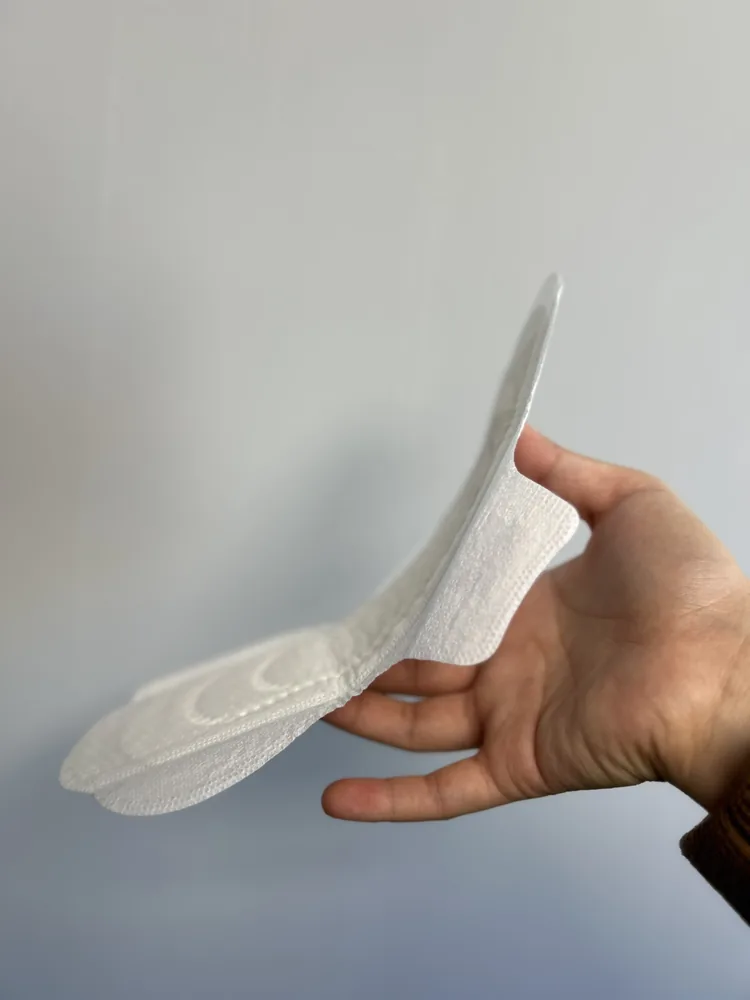
Pinch the pad between two fingers. Watch which way it wrinkles.
Up is good. Down is trouble.
If it wrinkles up toward you — the product stays hugged against the skin. Liquid hits the absorber the moment it leaves the body, side-leak risk drops, and there's less rubbing. If it wrinkles down, away from you, that's the bad shape: the body and the product have separated, gaps open up, and side-leakage becomes a real concern.
An old engineer I trust calls it the pinch test, and he's right that almost nobody at the buying end does it. They read the lab report instead.
Why the lab report lies
Here's the catch. Every standard test I've seen evaluates a pad laid flat on a table. Real use is two legs squeezing it for hours. Flat, a bad pad can look fine. Squeezed, the one that wrinkles down pops open exactly where you don't want it to.
"All the test standards lay the pad flat on a table. In real use your legs squeeze it and it wrinkles." That's the whole problem in one sentence.
The tail detail most buyers never see
Movement makes it worse. On a bike or a run, the panty moves against the pad and if they're not stuck together, the tail frays and pills. The fix is structural, not material.
We cut the tail concave — like an airplane tail — instead of round. The body curves back and up there, and a round tail floats in the gap and shifts. Concave follows the skin, so it shifts less and rubs less. On sport and period-panty styles we also put a slit in the core so the whole thing collapses upward when squeezed instead of folding down.
None of that shows up in a catalog photo. It shows up at hour four of a long day.
What to ask your factory
Next sample you get, pinch it on the call. Ask the engineer "which way does yours wrinkle?" If they look at you blank, that's your answer about how deep their process control goes. The distribution layer underneath and the humidity story are the other two checks I'd pair with this one.
For private-label programs we document the pinch direction per SKU at our OEM specs — it's a cheaper quality gate than most buyers realize.
FAQ
Why does a pad pass flat lab tests but leak in use?
Because squeezing changes its shape. Flat tests can't see the gap a down-wrinkle opens when legs compress the product. The pinch test simulates that squeeze in seconds.
What's the concave tail actually for?
It follows the body's curve at the back instead of floating in the gap a round tail leaves. Less shift, less friction, less tail pilling during movement.
Can I do this on a period panty?
Yes — pinch the gusset section the same way. You're checking whether the absorbent area hugs the body or folds away from it under squeeze.
Does wrinkle direction matter more for overnight pads?
Especially. More time compressed against the body means more opportunity for a down-wrinkle to open a leak path. We spec upward-collapse structures hardest on overnight and sport styles.
Turn this guide into an OEM brief
Share your product direction, target market, packaging idea and sample questions. Nafei can help translate the buying guide into a practical RFQ discussion.
- Product type: period pants, sanitary pads or mixed OEM project
- Target country, channel and buyer positioning
- Size range, material preference and sample review focus
- Private label artwork, pack count and estimated quantity