
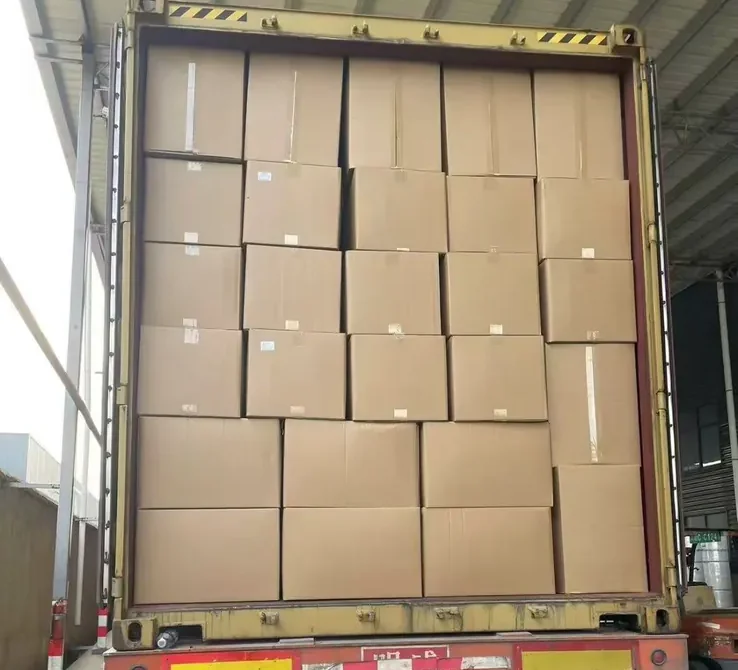
Most buyers treat ocean freight as a rate to be negotiated. It is closer to a rental: you take possession of a steel box with an unknown past, keep it for a number of days that are counted against you, and hand it back. The rate is the smallest part of that arrangement. What decides whether sanitary pads arrive saleable is what the box was doing before it reached you, and how long you keep it.
Sanitary Pads Sea Freight Buys You a Box, Not a Route
A rate is quoted per box, per route, per month. What changes hands is possession. The carrier gives you a steel unit that has already worked, you hold it for a counted number of days, and you return it in a condition that someone will inspect. The rate pays for the transfer of the box between two points, and for nothing else.
For a light, bulky product this distinction decides more than the freight number does. The cargo will not strain the box. It will fill it, at the volume limit, for the whole voyage, and every property of the box becomes a property of the shipment. A floor that held a powder, a panel that breathes moisture, a roof that drips at dawn, all of it reaches the product through the carton.
So when a buyer asks what sanitary pads sea freight should cost, the honest answer is that the quote covers carriage and stops there. Condition at handover, time on the ground, and the record made at loading sit outside the rate, and that is where the losses appear.
The Container Arrives With a History Nobody Records
Boxes are not washed between trips. They are swept out, checked for holes, and released back into the pool. The floor may have carried a powdered ingredient, a resin, or a load of green coffee, and whatever has soaked into the boards is still there when your cartons go in.
The document that describes the box at handover does not help. An equipment interchange receipt notes damage, because damage is charged for. A stained floor is not damage, so it is not noted, and nobody is billed for it.
This is why outer-carton complaints on pads so often trace back to the box rather than to the line. The product inside its wrapper is untouched. The carton that a distributor photographs has been marked by something that happened before loading, and by the time the photograph exists the cause is a thousand kilometres behind.
A short check while the box is still empty changes that: floor, lower panels, roof, and smell, photographed with the container number in frame. It is the cheapest evidence in the entire file, and the inspection step before sealing is where it belongs.
Two Signatures at the Gate, None in Between
The receipt is signed twice, once when the box leaves the terminal and once when it comes back. Both signatures belong to the carrier side and the driver. Nothing is signed during the days the box stands at your factory, which is precisely when it is loaded.
A claim file therefore holds a start state and an end state with nothing in the middle. The carrier will point at the loading; the shipper will point at the roof. Neither is acting in bad faith. The paperwork simply cannot carry the argument, which is the part of factory despatch that no one rehearses. It is also the part of sanitary pads sea freight that nobody quotes for.
One photograph sequence closes the gap, and it has to be taken by the party that benefits from it. Waiting for the carrier to document something it is not paid to document is not a plan.
Free Time Starts at the Gate, Not at the Vessel
Here is the part that catches first-time importers. The free days attached to a box begin when the box leaves the terminal, not when it is lifted onto the ship. Keeping it at the factory as overflow storage spends an allowance that was meant for the water leg.
Two separate charges sit behind that allowance and they are not the same charge. One is levied on the yard space the box occupies; the other on the box itself. They start from different events, they appear on separate invoice lines, and neither one announces itself before it begins.
Pads sharpen this because they are light. A container fills long before it approaches any weight limit, so there is no unused capacity to absorb a late carton. If the final SKU is not ready, the choice is to sail with empty space or to hold the box and pay for the privilege.
A Seal Proves Closure, Never Contents
The seal is a single-use closure and its number is written into the bill of lading. It answers one question, whether the doors were reopened in transit. It says nothing about what went inside, and it is not asked to.
That is the gap that loading photos are supposed to close, and it is why most loading photos fail. A shot of a stacked interior taken from the doorway proves nothing unless the seal number is legible in the same frame. Without it, the picture cannot be tied to any particular box on any particular day.
The same logic runs through the wholesale pads supply chain in the other direction. An importer who receives a clean seal and a mismatched carton count has two documents that disagree, and the disagreement is resolved by whoever took the better photographs.
Where Incoterms for Sanitary Pads Split the Box Risk
Buyers tend to read the trade term as one line that says who pays. It actually draws three lines, and they do not fall in the same place: where cost passes, where risk passes, and where responsibility for the condition of the box sits.
The third line is usually left blank. A term can put freight on the seller and risk on the buyer while leaving a dirty floor unassigned. When a claim is filed, that unassigned question is the one that decides the outcome, whatever the invoice says about who paid the carriage.
What to Record Before a Sanitary Pads Container Shipment
A file that can survive a claim holds four entries. Each is useful only inside a window, and once that window closes no later document can reconstruct it.
| Record | Who makes or signs it | When it stops being useful |
|---|---|---|
| Equipment interchange receipt | The yard and the driver, at both gates | Once the box leaves your ground |
| Seal number | Whoever closes the doors last | At the first inspection abroad |
| Loading photographs | Your own loading crew | If the seal is not in the frame |
| Carton count by SKU | The shipping desk, at the door | If it is copied rather than counted |
Read the right-hand column again. Every entry weakens after the event, which is the argument for making it at the time instead of assembling it afterwards. A carton and pallet specification from the packaging file belongs in the same folder, because the count and the carton must describe the same object.
Why a Sanitary Pads Delivery Schedule Slips at the Last Carton
Ocean time is the part of the plan that nobody controls and everybody builds around. What slips is the land side. The box arrives, the line is not finished, the box waits, and the vessel sails without it or with half a load.
A factory can only answer for the segment it owns, from material release to the last sealed and counted carton. Everything after that belongs to a booking desk, a trucker, and a terminal gate, and each of those has its own queue on the day.
That is why a useful answer to a delivery question splits the timeline in two. Ask a supplier to separate the part they control from the part they book, and the reply says more than one promised date ever could. The same holds for any sanitary pads sea freight booking: the transit time is the one number everyone quotes and nobody can move.
Four Questions to Ask Before the Doors Close
Most of the cost of a poor container is settled in the last hour, when the truck is waiting and everyone wants to go home. Four questions, asked at that moment, decide how much of the file will hold up later.
- Is the seal number readable in the loading photographs, in the same frame as the cargo?
- Were the floor and the lower panels photographed while the box was still empty?
- Was the packing list counted at the door, or copied from the invoice?
- Has anyone written down which free-time allowance applies, and when it started?
All four answers should take seconds to give. If any one of them needs a phone call to establish, the file is already weaker than it looks, and the weakness will surface at the worst possible moment: after the cargo is unloaded and the cartons are on a distributor floor.
We have made disposable menstrual pants and sanitary pads since 1998 and ship from China, holding no inventory in a destination market. If you are planning a first container and want the loading record and the carton specification agreed before the box is booked, send us your loading plan and we will mark up what the file still needs.
Frequently Asked Questions
Who pays for the container while it waits at the factory?
The buyer side usually does, through the free-time allowance that started when the box left the terminal. Once that allowance runs out a charge begins, and it is invoiced to whoever holds the booking rather than to whoever caused the delay.
Does a seal number show what was loaded into the box?
No. A seal records that the doors were closed and not reopened afterwards. To tie a loading photograph to a specific box, the seal number has to be readable in the same frame as the cargo behind it.
Can a supplier check the container before loading starts?
Yes, and the check is visual only. Floor, lower panels and roof are inspected for stains, moisture and odour before the first carton goes in, and any finding is photographed while the box is still empty and identifiable.
Why does a delivery date hold on paper and fail in practice?
Because the date usually describes the ocean leg, which is scheduled weeks ahead, while the land leg is booked day by day. The segment a factory controls ends at the sealed carton, and everything after it depends on a trucker and a terminal.
What belongs on a packing list for a pads container?
Cartons by SKU, counted at the door rather than copied from an invoice, with the container number and the seal number written on the same sheet that the loading photographs are filed under.


