
How SAP Core Design Supports Period Pants OEM Projects
2026-08-04
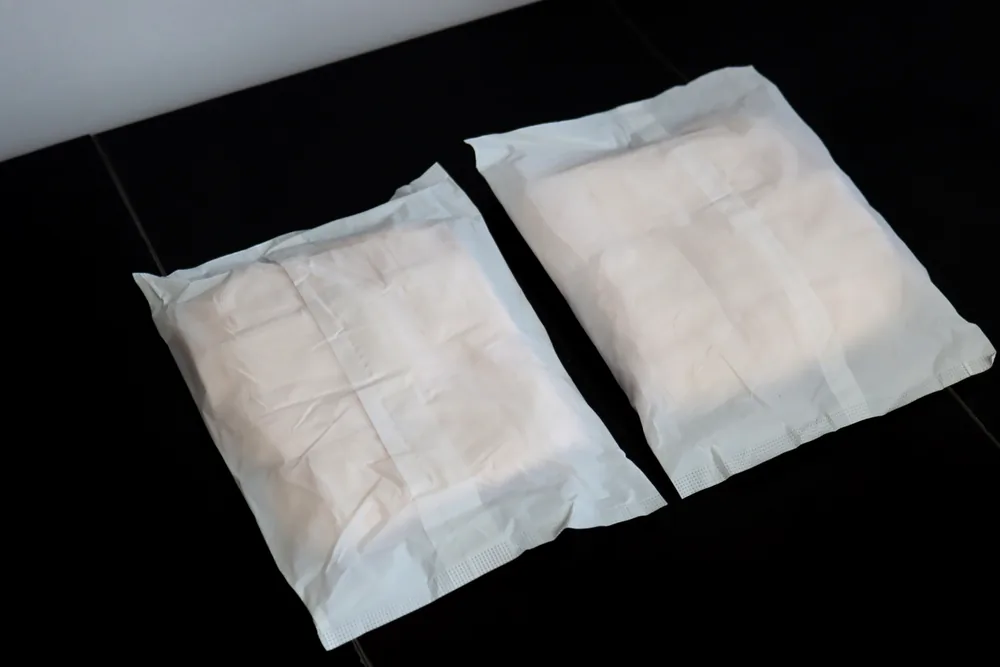
Absorbency is the spec buyers ask about most, but “how absorbent” is really a question about core design. This article explains how super absorbent polymer (SAP) cores work and what OEM buyers should specify to match their market.
What SAP Is
SAP (super absorbent polymer) is a granular material that absorbs many times its weight in liquid and forms a gel that holds the fluid under pressure. In disposable period pants, SAP works with fluff pulp to build a core that captures and locks liquid away from the body. The right SAP grade and loading largely determine how the product performs in real use.
How the Core Is Built
A typical core has two jobs: move liquid into the core quickly, then lock it. An acquisition or distribution layer on top spreads fluid so it does not pool in one spot, while the SAP-and-fluff mix below absorbs and retains it. A well-designed core keeps the topsheet more comfortable because liquid is pulled away from the skin rather than sitting on the surface.
Thinness vs. Absorbency
One common misconception is that “ultra-thin” means “low absorbency.” In practice, a higher SAP ratio lets a slim core hold more liquid, so thin pants can still offer strong protection. The trade-off is feel and cost: more SAP supports thinner profiles and higher capacity, while more fluff gives a softer, more pad-like hand feel. Buyers choose the balance based on the use case.
Heavy Flow and Overnight Protection
For heavy-flow and overnight scenarios, the core is tuned for larger total absorption and steadier performance over a longer wear window. Products such as overnight disposable menstrual pants are designed with a wider, higher-capacity core and a leak-guard structure intended to reduce side-leakage concerns during sleep. The aim is comfortable overnight protection, not an absolute no-leak promise.
Sample-Based Absorbency Review
Specifications on paper only go so far. The most reliable way to confirm absorbency is to request samples and test them under conditions close to real use — volume, timing and body position. A capable OEM supports raw material inspection and finished product performance review so the core you approve is the core you receive in bulk.
Quality and Absorbency Testing
Absorbency should be checked at more than one stage. In-process checks catch material or ratio drift during production, while finished product performance review confirms the delivered lot meets the agreed specification. Buyers can ask how the manufacturer records and tracks these checkpoints, and whether third-party testing is available for sensitive markets.
A Buyer Checklist for Specifying Absorbency
- Define the target use case: daily, overnight, heavy flow, postpartum or postpartum care.
- Agree a measurable absorbency target and a test method with the manufacturer.
- Decide the SAP-to-fluff balance for the feel and thinness you want.
- Confirm the leak-guard and fit design for the wear scenario.
- Approve with samples, then verify the bulk lot against the same specification.
Frequently Asked Questions
How absorbent are disposable period pants?
Absorbency depends on the core design and target use case. Overnight and heavy-flow versions use a higher-capacity core; confirm a measured target with samples rather than relying on a generic claim.
What does SAP do in a period pants core?
SAP absorbs and gels liquid so it stays locked in the core under pressure, which helps keep the surface drier and supports a slimmer profile.
Can thin pants absorb as much as thicker ones?
Often yes. A higher SAP ratio lets a slim core hold more liquid, so thinness and absorbency are balanced through core design rather than being opposites.
How is absorbency tested in OEM projects?
Through in-process checks and finished product performance review, sometimes with third-party testing for specific markets. Agree the method with your manufacturer up front.
Are period pants safe for heavy flow?
For heavy-flow use, choose a core tuned for larger absorption and a leak-guard structure. Review samples under realistic conditions and confirm the specification before bulk production.
Specifying a core for your market? Tell us the use case and target absorbency, and we will review SAP, fluff and leak-guard options with you.
Turn this guide into an OEM brief
Share your product direction, target market, packaging idea and sample questions. Nafei can help translate the buying guide into a practical RFQ discussion.
- Product type: period pants, sanitary pads or mixed OEM project
- Target country, channel and buyer positioning
- Size range, material preference and sample review focus
- Private label artwork, pack count and estimated quantity