
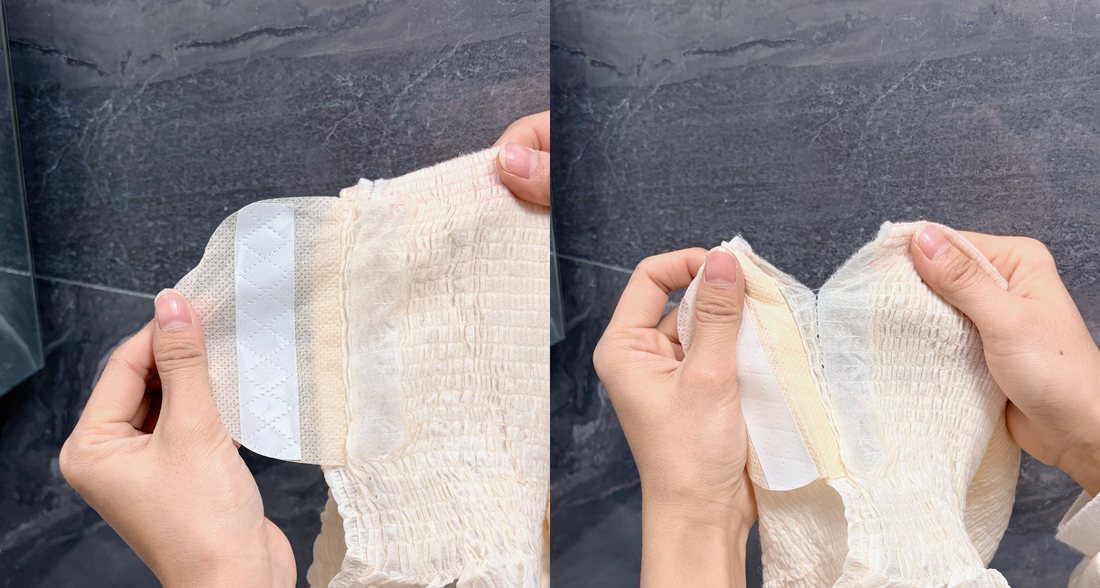
Plus-size overnight period pants usually get specified as a footnote to the standard programme: take the overnight pant that already sells, widen the waistband, change the size code on the bag. That approach produces a sample which passes a bench check and then generates returns, because on a larger body the pant loads in a different place and fails for a different reason.
This note covers the four places where a plus-size overnight pant is genuinely a different build, what a sample review should actually test, and how the pack and the size curve change the commercial maths before any artwork is approved.
Why scaling up a standard overnight pant fails in the core
A period pant is a fixed-width absorbent core sitting inside a garment. When the garment is widened, the core is usually carried over unchanged, so the dry margin between the core edge and the leg gather grows. On a larger body that margin is exactly where fluid arrives first when the wearer is lying on her side, and it is the last place a bench test looks.
Absorbency itself does not scale with the chassis. A pant that carries an overnight load on an M body carries the same core on an XL body, where the same volume has further to travel before it reaches the core, and a longer path to the side once it has.
The practical consequence is that a plus-size leak complaint is rarely solved by a thicker pad or a longer wear time. Either the core widens with the chassis, or the leg cuff has to do more work than it does on the standard size. Those are two different engineering decisions, and they cost different amounts.
Where the waistband has to change
Elastic tension is set per centimetre of relaxed band. Keep the same tension and grow the circumference, and the total force around the body rises with it — which on a plus-size wearer shows up as a band that rolls over at the waist, marks the skin, or both. The band also has to sit above the widest point of the body rather than across it, and that position shifts with the size range.
Three measurements belong in the specification rather than a single "size" label:
- Relaxed circumference — what the band measures flat, which sets the fit at the low end.
- Stretched circumference at a stated multiple — usually around 2.5×, which sets whether the pant goes on without a struggle.
- Recovery after three stretch cycles — the number that predicts whether the band is still holding on the second night, or sagging by the fourth hour.
On pull-up constructions the waistband is also the only thing holding the pant up, so band recovery matters more there than on a side-open pant that is re-fastened each time. The tension drift that shows up on standard sizes is magnified on a larger band, and it is worth reading the waistband tension note alongside this one.
The leg opening is where the leak path actually opens
On a larger size the leg opening follows a longer curve, and a gather that was specified for a shorter curve will not sit flat along it. The failure is quiet: the cuff looks correct on a table, the sample passes a visual check, and the complaint arrives as "it leaked at the side" three weeks after launch.
What to look at, in order:
- Gather count and spacing — the number of elastic strands along the cuff, and whether they stay evenly spaced when the opening is stretched to its working width.
- Cuff height — a taller cuff on a larger opening gathers more material and can fold under body pressure; a shorter one can invert.
- Where the cuff meets the core — the join is the point where a wide dry margin turns into a channel, and it is the first thing to inspect on a cut sample rather than on a finished one.
For an overnight product the relevant trial is a side-lying one, not a standing one. A pant that survives a standing check and fails when the wearer lies on her side has not been tested for the occasion it was sold for.
Length, bulk and what the overnight claim can carry
Longer bodies are usually the first answer to overnight coverage, and on this segment the sample we photograph runs to roughly 480 mm — long enough to cover the rear when the wearer is lying down, which is where the claim is actually won or lost.
Length has a cost that does not appear on a spec sheet: bulk between the legs. A long, thick pant is uncomfortable in exactly the posture it was designed for, and discomfort produces the second-most-common return reason after leakage — "too bulky to sleep in". Embossing or channelling the core so it bends along the body line is usually a better answer than adding material, because it improves how the pant sits without adding absorbency the wearer does not need.
What a plus-size sample review should test
A bench review answers whether the pant is built correctly. It does not answer whether it works on the body it was built for. Before approving a plus-size overnight sample, ask for:
- A wear trial across at least three body types within the size, not one wearer — plus-size covers a wide range of shape at the same nominal size.
- An eight-hour measurement of where the pant has moved, stretched or marked, taken at the end of wear rather than the start.
- A side-lying test with a measured volume, recorded as pass or fail per wearer rather than as an average.
- A re-fastening test on tab constructions — tabs that hold on the first closure and let go on the third are a common and cheap-to-fix defect.
- Bag fill and stack height once the pant is folded, because a longer pant changes how many units fit a bag, a carton and a pallet.
Pack format: why five counts sell in this segment
Plus-size overnight is a considered purchase rather than a routine one. A buyer trying a new brand at a higher unit price will take a five-count before she takes a ten, and a five-count also lets a retailer stock the size without committing shelf depth to a size that may not move.
The trade-off is real and worth stating plainly: fewer units per bag means more bags per carton, more film per piece and a higher packing cost per unit. The pack count cost note walks through where that cost actually lands. For a launch pack the extra cost is usually worth paying, because the alternative is a ten-count that stalls on the shelf and gets discounted — which damages the price position the brand needs later.
MOQ maths when the range carries five sizes
The starter threshold we quote for a private label run is 10,000 pieces per size. On a plus-size range that multiplies quickly: five sizes at that floor is 50,000 pieces before a single carton ships, and the size curve is rarely even — L and XL usually carry the volume while 3XL moves slowly.
Two things follow. First, launch on two or three sizes and add the tail once the curve is known, rather than opening the full range to hit a round number. Second, settle the size split before artwork, because the bag front carries the size and reprinting a run to fix a split is the most expensive way to learn it.
What to put in the brief
- Wear occasion — overnight, postpartum, or both. Postpartum changes the absorbency target and the closure preference.
- Size curve and launch sizes — which sizes open, which follow, and the expected split between them.
- Construction — pull-up or side-open with tabs, since the waistband and re-fastening requirements differ.
- Pack count and format — bag or box, count per pack, and whether the pack is a trial or a value format.
- Market and labelling — where it sells, which language the pack carries, and which claims the market will accept.
The size guide sets out how the range is normally split, and the OEM programme page covers sampling, packaging confirmation and how a brief turns into a quotation. If the same range also needs a hot-climate variant, the cooling pant note covers the material decisions that change with it.
Nafei builds both pull-up and side-open overnight constructions on the same site, so a plus-size range can be sampled in both before the size curve is fixed. The period pants range page shows the formats the programme is built from.