
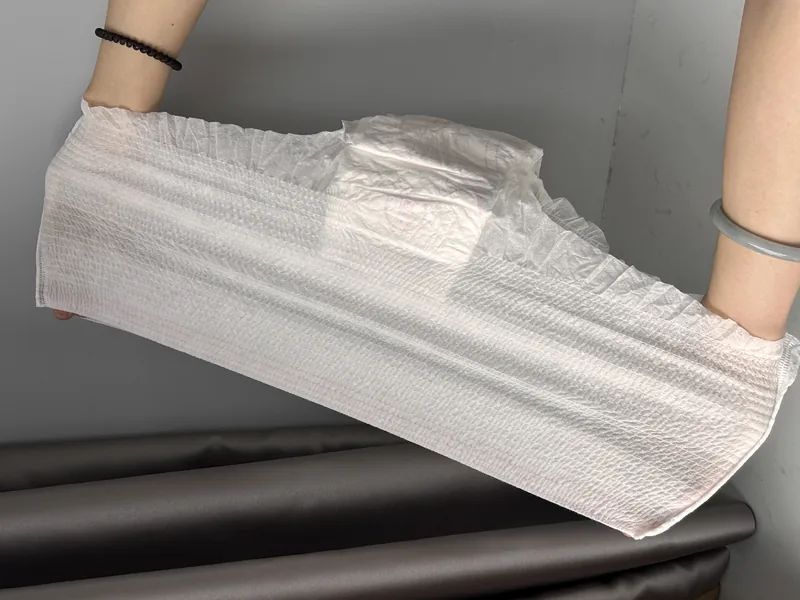
When a buyer sends back a container of pull-up menstrual pants with a leakage complaint, the first instinct is to test absorbency. Nine times out of ten the core is fine. The problem is sitting twenty millimetres higher, in the elastic waistband.
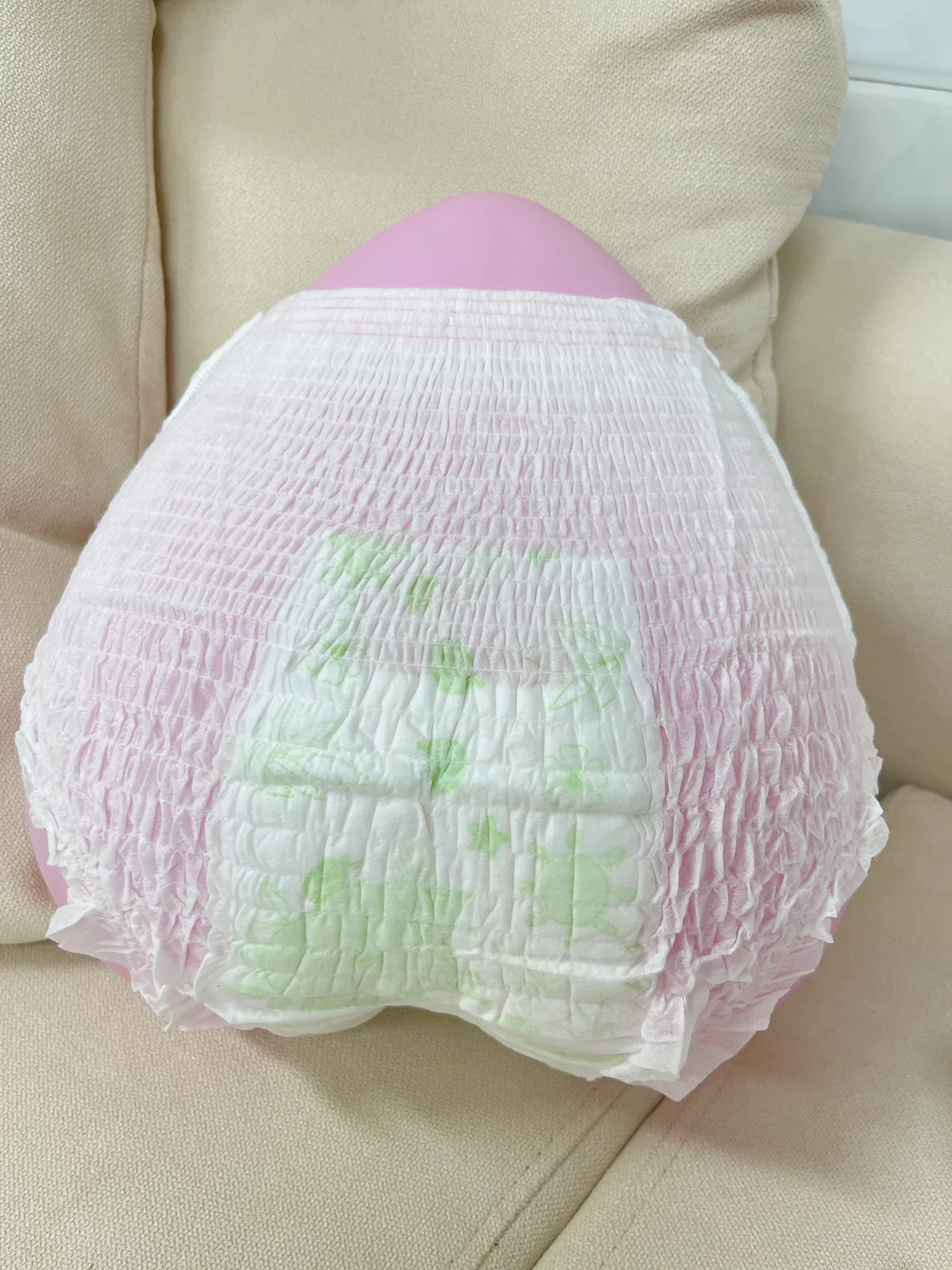
A pull-up pant is a closed tube held on the body by one continuous elastic ring. There is no side seam to adjust, no tape to re-close. If that ring is tighter than the spec, it pulls the crotch section up and out of position. If it is looser, the garment migrates during wear. Both failures read to the consumer as "it leaked", and both are invisible in a finished-goods inspection.
What actually moves the tension
Waistband tension is set by four inputs, and any one of them drifting will shift the finished garment:
- Elastic basis weight. A supplier change of half a gram per metre is enough to move tension outside a narrow tolerance. This is the most common cause and the hardest to spot, because the material looks identical on the roll.
- Elastic draw ratio. How far the elastic is stretched before it is bonded. Small changes in line speed change the effective ratio.
- Adhesive application weight. Under-applied adhesive lets the elastic slip locally, creating tight spots and slack spots in the same waistband.
- Web tension upstream. If the nonwoven is feeding unevenly, the elastic is bonded at inconsistent extension even when the ratio setting has not changed.
There is a fifth factor that is not mechanical at all: ambient temperature on the line. Adhesive behaves differently at 18 °C and at 34 °C, and a line that was set up in the morning will not hold the same bond strength at the end of an afternoon shift.

Why the defect does not show up in final inspection
A finished pant lies flat in a bag. The waistband is relaxed. Tension only becomes visible when the garment is stretched onto a body, and no factory stretches every unit before packing.
What factories measure instead is a proxy: a cut length of waistband is stretched to a fixed extension on a bench rig and the force is read. This is a destructive spot check, typically a handful of units per shift. It catches gross drift, not gradual drift.
The practical answer is to measure at the point where the elastic is bonded, not at the end of the line. A tension readout on the elastic path costs far less than a returned container, and it turns a lagging indicator into a live one.
What to put in the specification
Most purchase orders state a waistband "feel" and nothing else. That is not a specification, it is a preference. Three numbers make it testable:
- Elastic tension at a stated extension. Give the extension value, not just the force, otherwise the number is meaningless.
- Tolerance band. A stated central value with no tolerance invites arguments at the end of the run.
- Test method and sampling point. Which rig, how many units, at what point in the process.
Add the elastic basis weight and the draw ratio, and you have a waistband that can be quoted, produced and disputed on evidence rather than on impression.
Where this connects to construction
Side-seam pants have a different failure mode. The seam takes the load, so tension drift shows up as seam creep rather than as garment migration. That is one of the reasons the two constructions cannot share a single quality checklist — a comparison we set out in the side-seam versus pull-up note.
If you are specifying a pull-up program, the stretch-fabric program page shows how waistband parameters are written into our own spec sheets, and the quality control page covers where in the process each measurement is taken.
A measurement plan that survives an audit
Stating a tension value in the specification is only half the work. The other half is deciding where it gets measured, how often, and who keeps the record. A plan that a third party can walk in and verify looks roughly like this:
| Parameter | Method | Measurement point | Frequency |
|---|---|---|---|
| Elastic basis weight | Supplier certificate plus gravimetric spot check | Goods-in | Per roll lot |
| Draw ratio | Line setpoint log, verified against a marked length | At bonding station | Every shift start |
| Waistband tension | Bench rig on a cut sample at a stated extension | End of line | Five units per shift |
| Adhesive add-on | Gravimetric, coat weight per square metre | At applicator | Every shift |
| Leg gather tension | Bench rig, same stated extension | End of line | Five units per shift |
Two details in that table matter more than the numbers themselves. First, the extension value has to be stated alongside the force — a force reading without an extension is not a measurement. Second, the record has to exist on paper or in the line system. A factory that can produce last month's tension log on request has a controlled process; a factory that can only produce a certificate has a controlled document.

Three failure signatures and what they mean
When a complaint does come in, the shape of the complaint usually points at the cause. These three are the ones we see most often:
- Roll-over at the waist edge. Tension too high relative to the stiffness of the nonwoven. The elastic curls the edge inward and the seal line takes peel load instead of shear load. Corrective action is usually basis weight or draw ratio, not a new elastic supplier.
- Pressure marks or red lines after two hours of wear. Absolute tension too high for the size band, or the size band itself is too narrow. If marks appear only at the top of the size range, the problem is sizing, not elastic.
- Sagging or migration after a few hours. Tension too low, or adhesive slip in one localised section. If the waistband measures correctly at the bench but the garment migrates, look for slip — a localised failure that averages out in a five-unit sample.
Each of those maps to a different corrective action, which is why the measurement plan has to distinguish between them. Replacing the elastic supplier is the most expensive response available and is rarely the right first move.
The factory audit and evidence page covers what records a buyer can expect to see on site, and the stretch-fabric programme page shows how these parameters appear in a live specification.
The short version: treat the waistband as a controlled parameter, not a comfort descriptor. It is where the complaint will come from.


