
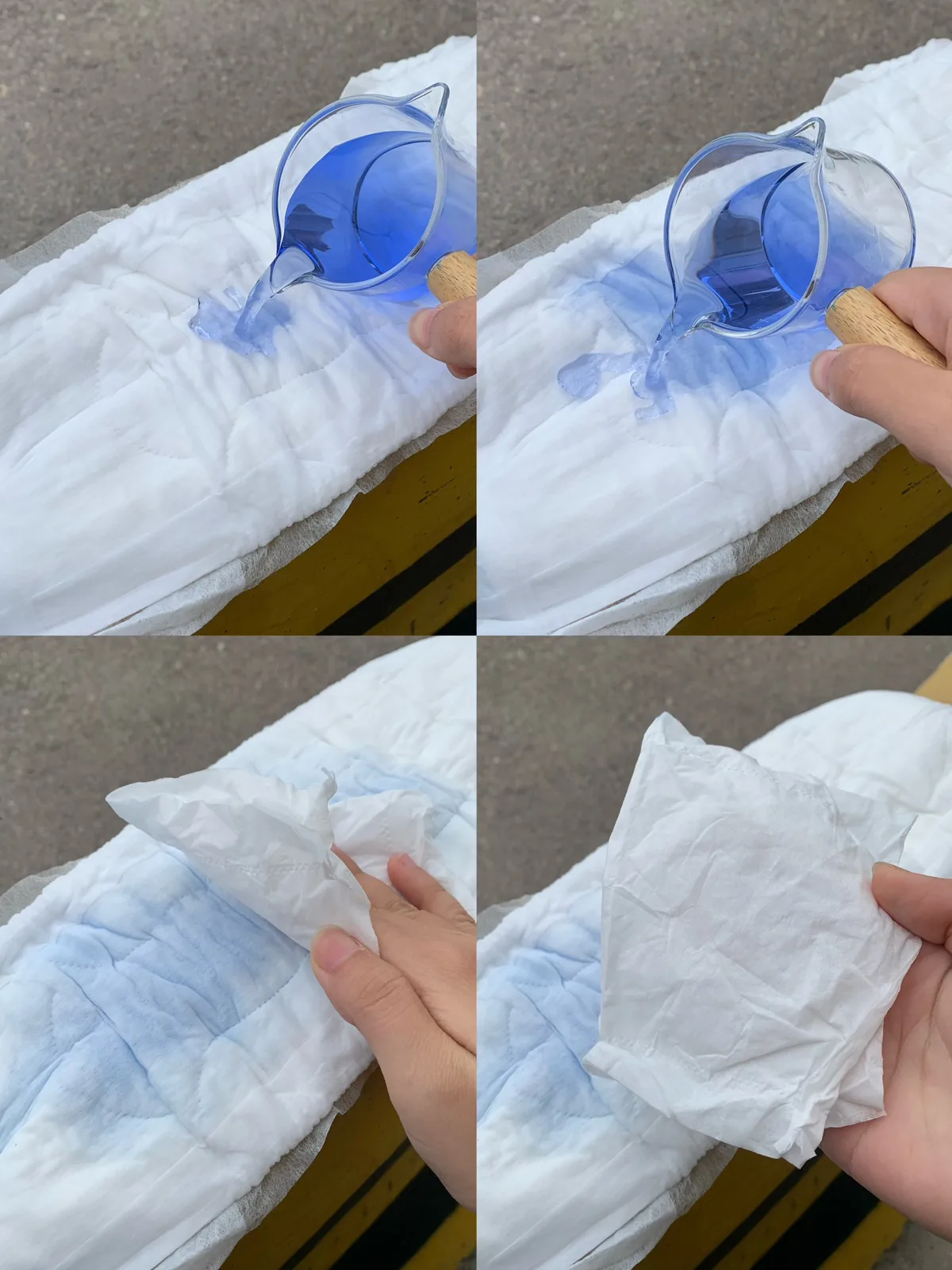
Two pads leave the same line with the same SAP load, the same core thickness and the same topsheet, and one of them feels wet at the back after an hour. Buyers usually read that as a quality problem and go looking for a stronger material. It is almost never a material problem. It is a pore problem: the liquid never reached the SAP that was paid for.
SAP Absorbent Core for Sanitary Pads: A Pore Network, Not a Percentage
A SAP absorbent core for sanitary pads is a stack: a pulp web, superabsorbent particles distributed through it, a carrier sheet that holds them in place, and enough densification to keep a thickness the line can run. Only one of the four appears on most purchase specs.
SAP load is a purchasing figure. It tells you what the core costs, and roughly how much liquid the material could hold if every particle were reachable. It says nothing about whether liquid arriving at one point can reach the particles near the ends of the pad.
Absorption in a pad is a transport problem before it is a storage problem. Liquid has to travel through the pulp web to reach dry SAP, and the web pores are the road. Close the road and the load figure becomes an inventory of unused material.
Gel Blocking Is a Volume Event, Not a Dosing Shortfall
Superabsorbent does not absorb like a sponge. It absorbs by swelling: the polymer network takes in liquid, expands, and occupies far more space than the dry particle did. In a confined core that expansion must go somewhere, and it goes into the pore space around the particle.
When the pores near the wetting point fill with swollen gel, the core seals itself locally. Liquid on top has no open path to the dry SAP further along, so it spreads sideways or stays where it landed. The wearer reports what the bench test does not measure: a wet front and a dry back.
The instinct then is to raise the dose, which usually makes the seal tighter. More particles mean more swelling inside the same volume, and a finer particle cut swells faster than a coarse one. That is how a higher load measures worse in use while still measuring better on a retention test.
Gel blocking in a SAP absorbent core for sanitary pads is a design question, not a purchasing one. The levers are pore size in the pulp web, the particle size distribution of the superabsorbent, and the density to which the core is calendered. None of them is the load.
Why a Denser Core Draws Faster and Holds Less Free Liquid
Calendering is the step buyers ask for without knowing it. Pressing the core to a thinner gauge is how a pad gets slim, and it changes the pore network in one way: smaller pores pull liquid in harder. Capillary pressure rises as pore radius falls, so a denser core wicks faster at the point of contact.
Void volume falls with thickness, so less room is left for liquid the polymer has not taken up yet. The core that draws fastest has the least buffer, and polymer uptake is the slow step. our converting lines are rated by the thickness range each can hold, not by one gauge.
That is also why slim products carry an acquisition layer older, thicker products did without. It is a temporary reservoir, sized to the rate at which liquid arrives rather than to total capacity, and it buys the core time to swell. Remove it and the slim pad must compensate with a denser web.
Fluff Pulp Sets the Pores Before SAP Ever Sees Liquid
The pulp is chosen first, and it constrains everything after it. Fiber length and the degree of refining decide how open the formed web is. Long, lightly refined fiber builds a bulky web with large interconnected pores: good permeability, and enough structure to hold particles in position during converting.
Refine the same pulp harder and the web densifies. Dry strength improves, dust falls and the sheet handles better at speed, but permeability drops. A fluff pulp for sanitary pad core is chosen on fiber length and freeness, not on price per tonne, because the cheap choice can cost more in superabsorbent that never gets wet.
Dust belongs in the spec too: fines from pulp and fractured polymer migrate to the seals and folding plates, and the symptom appears at packing long after the absorbency test passed.
The Airlaid Carrier Decides Whether SAP Stays Where It Was Dosed
Airlaid paper is formed dry, so it holds a uniform particle distribution and a stable thickness, and it is bonded either thermally or with a latex binder. At the same weight the two are not interchangeable. Thermal bonding gives a dimensionally stable sheet that resists particle migration through winding, compression and folding. It is also stiffer, and a stiff carrier can crack along the fold line of a wrapped pad, while latex bonding gives a softer hand but a bond more sensitive to line temperature.
The carrier does two jobs: during converting it keeps the particle bed from shifting, and in use it stops superabsorbent migrating to one end when the pad is compressed in its wrapper. Approving a new airlaid paper supplier for sanitary pads is a line trial for that reason, not a paperwork change.
Perforated Film Topsheet: Strike-Through and Rewet Pull Opposite Ways
A perforated film topsheet for sanitary pads is an engineered funnel array, not a sheet with holes punched for ventilation. Open area, hole taper and hole density together set two properties that move in opposite directions.
Widen the open area and liquid crosses quickly, so the surface clears on contact. The same openings let liquid return under body pressure: that is rewet, and rewet is what the wearer notices. Narrow them and the surface stays drier, but liquid must spread sideways, and the pad edges start absorbing.
Registration is the second constraint. Film runs as its own unwind with a registration mark, so tolerance accumulates across film, acquisition layer and core. Misregistration does not appear as a hole in the wrong place. It appears as an asymmetric margin and a funnel pattern sitting off where liquid lands.
Dry feel is therefore a property of a pair, topsheet and acquisition layer, decided at the interface between them. Neither can be specified alone and still be predicted.
What a Retention Figure Actually Measures, and in What Liquid
A retention value comes from soaking a sample for a stated time, draining or centrifuging it under a stated load, and weighing what stays. Change the soak time, the load or the liquid and the number moves. A figure quoted without those three conditions is not comparable to anything.
The liquid matters more than most buyers expect. Superabsorbent is a polyelectrolyte gel: swelling is driven by osmotic pressure and restrained by ionic crosslinks inside the polymer network. Dissolved ions screen the charge and crosslink the gel, so swelling falls as ionic strength rises. A core tuned against saline is tuned against a liquid the product will not meet.
Menstrual fluid is viscous and carries protein and cells, which changes both how fast liquid enters the pore network and how the gel surface behaves. That does not make saline testing useless; it makes the condition part of the specification. The questions we are asked most about this sit on the FAQ page.
How to Write the Core Into a Purchase Spec
A SAP absorbent core for sanitary pads that can be quoted and compared has to name the layers and the conditions, not only the load. The table below is close to the minimum we would accept from a material supplier.
| Spec line | What it controls | What it still cannot tell you |
|---|---|---|
| Superabsorbent load and particle size distribution | Cost, and swelling inside a given pore volume | Whether liquid can reach the far end of the core |
| Pulp type, fiber length, freeness | Pore size and permeability of the formed web | How the core behaves after compression in the wrapper |
| Core density and calender gap | Wicking speed, thickness, pack height | Whether the surface stays dry under body pressure |
| Carrier type and bonding method | Particle retention through converting and folding | Fold-line stiffness in the finished pad |
| Topsheet open area and registration tolerance | Strike-through rate and surface dryness | Rewet at the acquisition interface |
- Wet at the back of the pad while the front is saturated
- Core cracking along the fold line after wrapping
- Loose polymer found at the seals or on the folding plates
- Thickness drifting between the first roll and the last
Two things belong beside that table: the test condition, meaning liquid, soak time, applied load and where the sample was cut, and the failure mode you are trying to avoid, named in plain words. A supplier that answers a load question with a load number and stops there has not finished the specification, and buying guide covers the same ground from the purchasing side.
We have converted pads in Guangdong since 1998, and the most expensive core we have seen was the one that met its load figure and failed at the back. If you are rewriting a spec, send the two figures you were given, load and core thickness, and say what the product must do at the far end. We will tell you which is binding, or that neither is. Build sheets are on our contract manufacturing page, trial quantities on the MOQ page.
Frequently Asked Questions
Does a higher SAP load always give a drier pad?
No. Load raises how much the material could hold, not how much liquid can reach it. Past a point, extra particles tighten the pore network and swell into the space liquid needs in order to travel, so a pad can read wetter at the back while the load figure improves.
Why is the back of a pad dry when the front feels wet?
That pattern is gel blocking. Swollen polymer near the wetting point fills the pores, so the core seals locally and liquid cannot move to the dry superabsorbent further along. The rest of the core is intact; it simply never received anything to absorb.
What decides whether a core needs an acquisition layer?
The rate at which liquid arrives, set against the void volume the core has left. A thin, densified core draws liquid in quickly but has little free space to hold it while the polymer swells, so an acquisition layer buffers the arrival.
Can two suppliers be compared using a retention figure alone?
Only if both figures come from the same liquid, the same soak time, the same applied load and comparable samples. Without those conditions the numbers are not the same measurement, and any difference between them may say more about the test than about the material.
Which liquid should a core be tested in?
Whichever liquid the product will meet, or a stated substitute with the condition written down beside the result. Saline is repeatable, but its ionic strength holds swelling back differently from a viscous protein-bearing fluid, so a saline figure should be labelled as saline.