
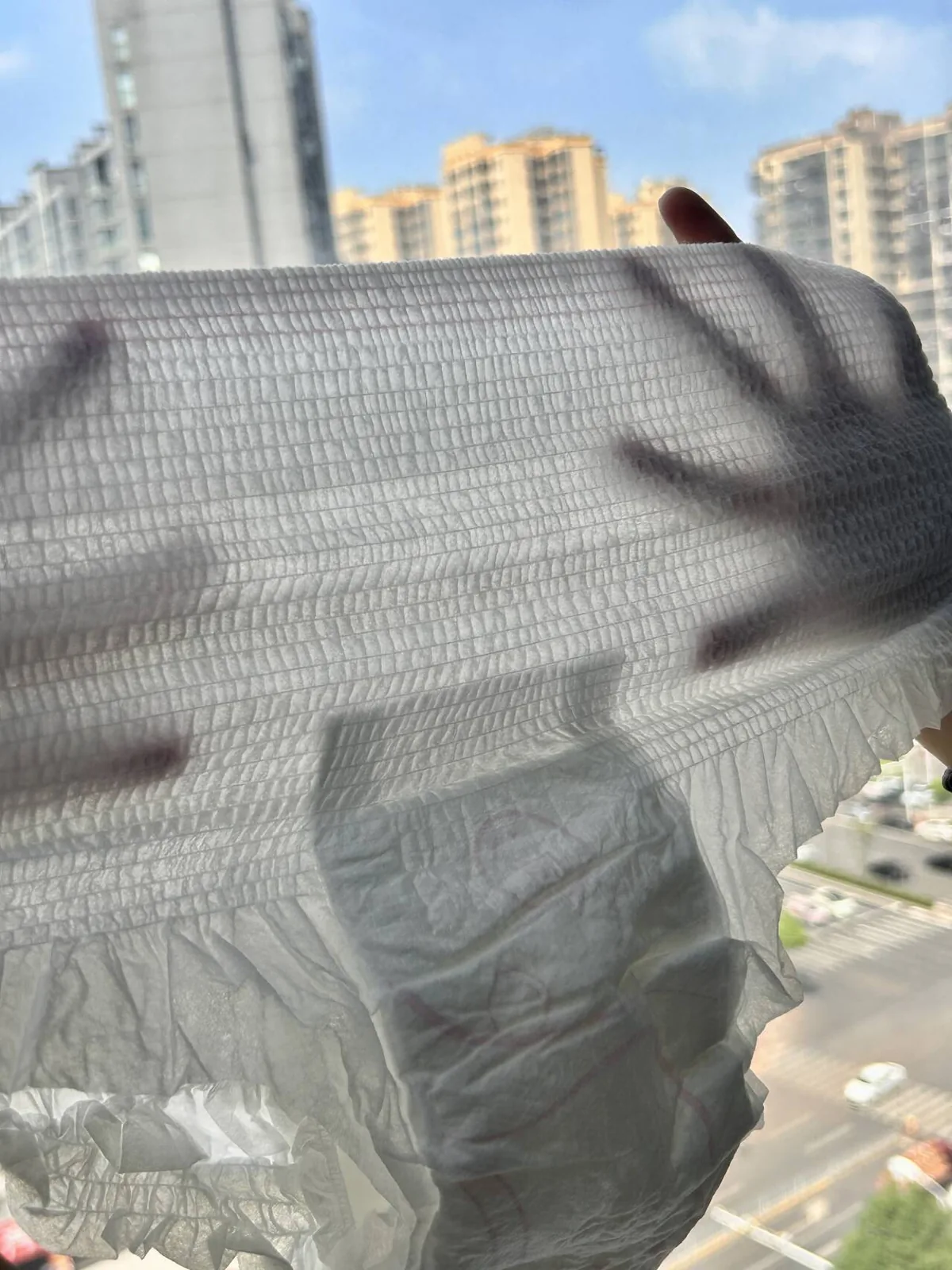
A buyer asks for a non woven backsheet because it feels like cloth. That is a reasonable instinct and it is also the point at which the specification stops describing the pad. The nonwoven is a surface. Under it sits a film that holds liquid, a bond line that keeps the two together, and an adhesive-and-liner pair that decides whether the pad opens quietly or tears. Name the material and you have named one of four decisions.
Non Woven Backsheet for Sanitary Pads: What the Phrase Fixes
The phrase non woven backsheet for sanitary pads does fix something useful. It tells the converter that the outside of the pad must not read as bare polyethylene, and it rules out the printed film a low-cost brief would otherwise reach for. What it leaves open is the barrier. A nonwoven web is bonded filaments with space between them; that space is why it feels soft and why it cannot be the layer holding liquid.
So the phrase is a purchasing category, not a specification. It says: give me the cloth-like face. It does not say which film, at what intrusion pressure, bonded how, with which adhesive against which liner. A sanitary pad supplier will answer those four questions from a cost sheet if the buyer does not.
The Nonwoven Layer Is Porous by Design
Spunbond webs are made by laying continuous filaments and bonding them at discrete points, so most of the structure is air. Porosity is not a defect to be engineered out: close the web and it becomes a film, and the reason for choosing it has gone. A visual check of a backsheet is inspecting the layer never asked to hold anything.
What the web does contribute is worth naming, because it is what the buyer is actually paying for:
- Abrasion resistance where the pad rubs against underwear, which a plain film lacks at the same low added mass.
- Opacity, which hides the colour of the core and any transfer that has already occurred.
- A matte face, which changes how the product reads on a shelf beside a glossy one.
- A surface that takes embossing, so the pad neither clings nor rustles.
Which Film Sits Under the Nonwoven
The film underneath the web is the only layer asked to stop liquid. Two families are in common use. A monolithic polyethylene film stops liquid because it has no continuous path through it. A microporous film is mineral-filled and stretched, which opens tortuous channels across its thickness; it passes vapour and resists liquid intrusion up to a pressure, and that pressure is a measured quantity, not a property of the material name. A buyer who writes 'breathable film backsheet sanitary pad' on a request has picked a family, not a barrier.
Every figure attached to a film travels with its method. A water column value, a hydrostatic resistance, a vapour transmission rate: each is produced at a stated temperature, on a stated specimen area, over a stated time, and each moves if any of the three changes. Two suppliers can quote the same number from different methods and be describing different films. Ask for the condition line first, because a number without conditions is a brochure.
The Bond Line Decides Where a Stain Appears
Laminating a web to a film is a bonding decision, and it is the one most often handed to the lamination and converting lines without instruction. The same adhesive applied by slot die, by spray or by gravure roller behaves differently on the same film: the outcome is either penetration into the web or poor anchorage to it.
Penetration is the quieter failure. If the adhesive is hot and thin enough to wick through the web, it reaches the outer face and sets there. The bond strength check passes, because the bond is genuinely strong. The pad fails in the hand instead: the area that should be soft is a stiff patch with a sheen on it, and on a dark product that sheen reads as a stain before any liquid is involved. A non woven backsheet for sanitary pads can be structurally sound and still be rejected for this.
Poor anchorage fails later and costs more. A bond that has wet the film but not the web holds a peel test taken on the day, then lets go after the cartons have been stacked. In use it shows as a wrinkle along the leg curve, then a tear.
Release Paper for Sanitary Pad Adhesive Is a Pair, Not a Part
Release paper is usually bought as an accessory and specified as a component. It is neither. Release force is a property of the pair: the silicone coat on the paper and the adhesive on the pad. Change one and the number moves, which is why a liner approved against one adhesive carries no information about another, and why a liner swapped for a cheaper grade is a product change rather than a purchasing change.
The direction of drift is predictable even when the value is not. Release force tends to rise as a wrapped pad ages, because adhesive flows into the paper and progressively covers the silicone. A liner that opens smoothly in the month it was coated can grab much later at the point of use. The opposite happens too: a liner that releases too easily lets the pad shift inside the wrapper and fold its adhesive onto itself.
The consequence is procedural. The release paper for sanitary pad adhesive has to be approved on an aged, wrapped pad held at the storage temperature, not on a flat specimen the day after coating. A release test taken at the coating line says the roll is consistent, not that the product opens.
Hot Melt Adhesive for Sanitary Pads: Open Time Against Line Speed
One pad usually carries two adhesives with different jobs, and they are routinely discussed as one. Construction adhesive bonds the layers and never touches skin. Positioning adhesive holds the pad to underwear and is covered by the liner. Where the product is individually wrapped, the wrapper seal is a third bond with its own requirement; the common specification questions explain why a single hot melt line on the brief comes back as a price.
Open time is what ties adhesive choice to line speed. Hot melt adhesive for sanitary pads is applied molten and has to be tacky when the nip closes. More open time than the line needs leaves it soft in the log, where wraps block and the roll will not unwind cleanly. Less and it skins before contact, so the bond depends on pressure instead of chemistry. Both faults show in the log and vanish in the finished pad.
Positioning adhesive answers a different question: whether the pad stays where it was put. That is creep rather than tack, measured by hanging a loaded specimen at an elevated temperature for a stated period and recording how far it slides. A probe tack reading taken on a bench says almost nothing about it.
The Wrapper Is Part of the Backsheet Decision
An individually wrapped pad is a two-barrier product. The backsheet keeps liquid inside; the wrapper keeps the outside world out until the moment of use. They are bought from different suppliers and approved by the same person, and the boundary between them is where a seal can be tight enough to hold and hot enough to distort the film beneath it. A wrapper change also alters the case pack and the printing plate, so it belongs in the first specification round rather than a later cost review.
What to Put on the Spec Sheet Instead
A material name is a purchasing category. A specification for a non woven backsheet for sanitary pads is a set of testable statements, and the table below maps four common brief lines to what they leave open and where the failure appears.
| Line on the brief | What it leaves open | Where the failure appears |
|---|---|---|
| non woven backsheet | which film, and at what intrusion pressure | a damp patch with no visible hole |
| breathable | the method and condition behind the vapour figure | condensation inside the wrapper, a cool damp feel at the edge |
| strong adhesive | which of the two adhesives, and against which liner | pad shifts on the garment, or tears when the wrapper opens |
| soft | whether softness comes from the web, the film or the bond | a stiff patch once the cartons have been stacked |
Filling the middle column is the work. It is also where a supplier's reply tells you what you are buying: one that returns the condition line, the adhesive grade and the liner grade is quoting a product; one that returns a price and a lead time is quoting a category.
One caution on the barrier line. Tightening it moves cost elsewhere: a film that resists more pressure usually gives up vapour transmission, and a bond that is stronger usually gives up softness. Those trade-offs are cheap to settle before tooling and dear to settle after a print run.
If you are rewriting a brief, send the four lines you already have and we will return each with the condition it needs and the test that settles it. Start with the barrier line, because it is the one most briefs leave blank. Reach the team through the contact page, or read the wholesale buying guide first if the brief is still being drafted.
Frequently Asked Questions
Is a non woven backsheet better than a plain film backsheet?
Not on its own. The web changes the feel and the abrasion resistance of the outside face, while the film beneath it decides the barrier. A plain film is the sensible choice where cost and a matte print matter. Where the outside face has to read as cloth, the laminated web earns its converting cost.
How do we compare two breathable film backsheet sanitary pad offers?
Ask for the condition line behind every barrier figure: specimen area, temperature, time and test direction. Two numbers produced under different conditions are not comparable, and a supplier who cannot state the condition is quoting a brochure rather than a measurement.
Why does a pad tear when the wrapper is opened?
Usually because release force has drifted upward since the liner was approved. Adhesive flows into the paper as a wrapped pad ages, so a liner tested on the day of coating can grab much later. Approval should be taken on an aged, wrapped pad held at the storage temperature.
Should construction and positioning adhesives be specified separately?
Yes. They do different jobs and fail in different ways. Construction adhesive is judged on bond strength after the cartons have been compressed, positioning adhesive on creep at body temperature. One line reading hot melt on the brief leaves the choice to the supplier, and the choice will follow cost.
What is the first line to fix in a backsheet specification?
The barrier line: which film family, which method, and the condition under which the figure was produced. Everything else in the laminate can be discussed around a barrier figure that both sides accept as comparable, and without that figure the discussion is about adjectives.


