
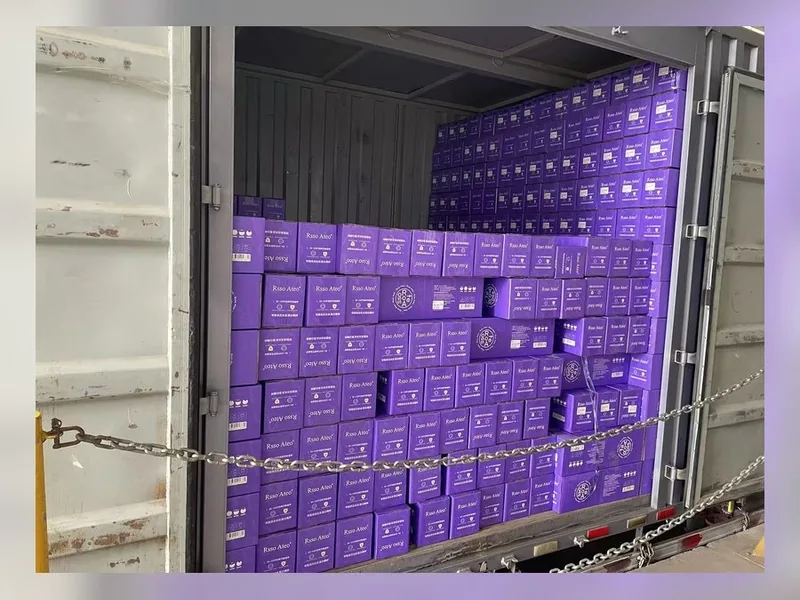
A lot number printed on a carton is only useful if it resolves to three things: the incoming material lots that went into the product, the line and shift that converted them, and the finished cartons that left the plant. If one of those three is missing, a complaint stops at the warehouse door. Sanitary pads batch traceability is therefore a record chain, not a marking exercise, and the chain has to be built while the order is running rather than reconstructed after a claim arrives.
What sanitary pads batch traceability has to resolve
The first question to put to a plant is not whether it has a system, but what one code opens. A finished-goods lot code should lead to a conversion record: which line, which shift, which work order, and which carton numbers were produced under it. That record should in turn lead back to the incoming lots of topsheet, acquisition layer, absorbent core materials, backsheet film, release paper and hot-melt adhesive. When the two ends cannot be joined, the factory can describe its process but cannot answer a specific question about a specific carton.
Buyers often ask for a certificate or a photograph instead of the chain itself. Neither proves that the pad in a disputed carton came from the material lots named in a document. Ask for one worked example: pick a carton mark from a recent shipment and have the plant walk it backwards to the reel and forward to the packing list. The walk takes minutes when the records exist and stalls immediately when they do not.
Why a carton mark is not a traceability record
A shipping mark identifies a carton for freight and receiving. It is chosen for the forwarder, the consignee and the warehouse, so it usually carries the order number, the destination and a carton sequence. Those fields are useful for counting boxes and useless for root cause. A mark can be identical across two production runs if nobody adds a run identifier, and that is exactly the case where a problem in one run contaminates the evidence for the other.
The distinction matters at the specification stage. State which fields the lot code must contain, where the code appears, and which document maps that code to the work order. Ask whether the code survives repacking, because a distributor who consolidates cartons can break the mapping by relabelling without recording the original marks. Version control on that mapping is part of factory capability, even though it sits in an office rather than on a line.
The material side of the lot
Each incoming reel, bale or carton of adhesive arrives with a supplier lot identifier. The plant records that identifier against its own receiving number, the date, and the result of incoming inspection. On the line, the consumption record links the work order to the receiving numbers actually opened. That is the join a buyer is really paying for: not a list of approved vendors, but evidence of which vendor lots were consumed on which order.
Materials behave differently here. Film and nonwoven arrive in discrete reels with clear splice points; fluff pulp and superabsorbent polymer arrive in larger units that may feed several work orders. A credible system acknowledges that a single incoming lot can span more than one finished lot, and that a single finished lot can draw on more than one incoming lot of the same material. Any claim of a one-to-one mapping across all layers should be checked against a real work order.
Five records worth requesting before an order
- The coding rule itself: what each position in the lot code means and who assigns it.
- A blank conversion record showing the fields filled in during a run, not a retyped summary.
- The receiving register with supplier lot identifiers for the main raw materials.
- The carton or pallet list that ties finished lots to the packing list and the invoice.
- The retention sample register, with the storage location and the condition check recorded.
Ask for blank templates as well as filled ones. A blank template reveals which fields the system expects and which ones are optional, and it is much harder to improvise than a polished sample document. It also tells you whether the plant records deviations during a run or only writes a clean sheet afterwards.
Retention samples and the time axis
A retained sample is the physical half of the chain. It allows a disputed property to be re-measured against the same lot months later, provided the sample has been kept in conditions that do not change the property in question. Storage conditions, sealing, and the identity of the person who pulled the sample all belong in the register. A bag of pads sitting on a shelf without a label is not a retention sample.
The retention period belongs in the specification and should follow the rules of the destination market and the shelf life declared for that product. Do not accept a verbal number. Write down the period, who holds the samples, what happens to them at the end of it, and how a buyer requests a retest. A short period may be fine for a fast-moving retail line and inadequate for a tender with a long delivery window.
How a recall drill exposes a broken chain
Traceability is testable in both directions. A forward trace starts with a suspect incoming lot and asks which finished cartons contain it. A backward trace starts with a complaint about one carton and asks which material lots and which line conditions produced it. Run the drill on paper with a real past order before a real complaint appears. The forward trace is the one that usually fails, because it requires consumption records rather than a filing cabinet of finished-goods documents.
| Step | Question | Evidence that answers it |
|---|---|---|
| Start | Which carton is disputed | Carton mark with lot code on the packing list |
| Back | Which work order made it | Conversion record with line, shift and date |
| Back | Which material lots went in | Receiving numbers linked to the work order |
| Forward | Which other cartons share those lots | Consumption and carton lists for the same period |
| Close | Was the same fault elsewhere | Retention sample retest and inline reject log |
The drill also shows whether the supplier documentation and the production records use the same lot vocabulary. A quality file that uses one code and a warehouse file that uses another will produce two plausible answers to the same question, which is worse than having no answer at all.
What changes when a range has many SKUs
Wide ranges multiply the mappings. Two pad lengths, three pack counts and two wrapper versions can be produced from the same material lots in the same week, so the finished lot code has to distinguish the SKU as well as the run. Packaging version is a separate axis again: a printed wrapper revision changes the saleable unit without changing the absorbent core. Treat artwork revisions as dated objects in the same record set, not as notes in an email thread.
This is where a buyer can make the system easier to operate. Freeze the specification before the run, avoid late artwork changes during a multi-SKU order, and keep the number of pack formats in a first order small. Each additional format adds another set of carton marks to reconcile, and an OEM production plan is only as good as the least disciplined of those sets.
Writing the requirement into the specification
Put the traceability clause beside the acceptance criteria, not in a general quality paragraph. Name the code format, the fields in the conversion record, the retention sample rules, the retention period, and the response time for a backward trace request. Say who pays for a retest and who keeps the results. These are commercial terms as much as technical ones, and they are far cheaper to agree before sampling than after a disputed shipment.
Then verify one order end to end. Sanitary pads batch traceability that works on paper during a quotation and fails on a real packing list is a documentation exercise. Ask for the worked example, keep it with the order file, and repeat the check when the range or the packaging version changes. If you want the clause reviewed against a real project, the team can walk through the record set with you.
Questions buyers ask about lot records
What should a lot number let a factory retrieve?
It should resolve to the incoming material lots, the converting line and shift, and the list of finished cartons shipped under that run. If any one of those three links is missing, a complaint cannot be traced to a cause and the record chain stops at the warehouse door.
Are retention samples part of sanitary pads batch traceability?
Yes. They are the physical half of the chain, because they let a disputed property be measured again against the same lot. A sample only counts if it carries the lot code, a pull date and a storage record, and if the storage conditions do not change the property being checked.
How long should traceability records be kept?
The period belongs in the specification and should follow the destination market rules and the declared shelf life of the product. Avoid accepting a verbal figure; write down who holds the records, who holds the samples, and how a buyer requests a retest within that period.
Can a distributor add its own lot codes?
It can, provided the original plant codes are recorded against the new ones at the moment of relabelling or consolidation. Without that cross-reference, a repacked carton loses its link to the production run and a backward trace ends at the distributor rather than at the line.
What is the first sign of a weak traceability system?
Ask for one worked example from a recent shipment and watch where the walk backwards stalls. Systems that exist only as finished-goods documents usually answer the carton question quickly and then fail when asked which raw material lots were consumed on that work order.