
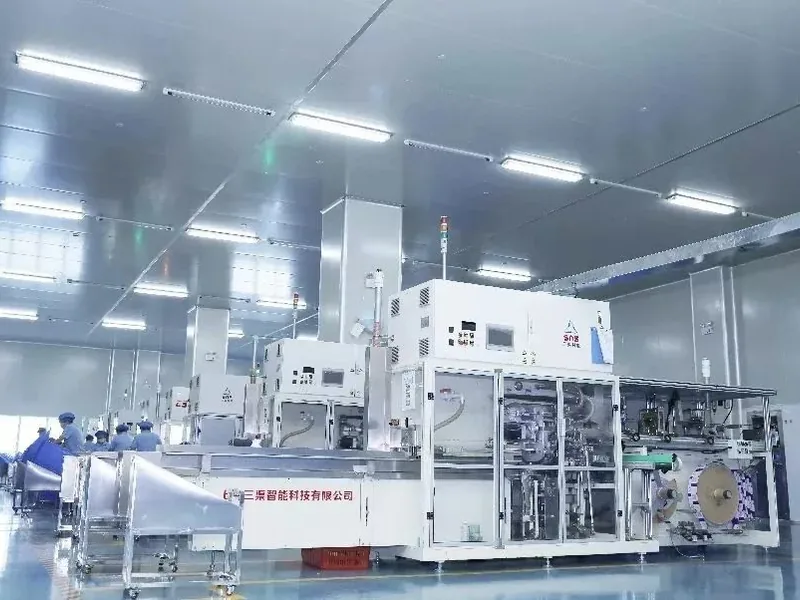
A vending project usually begins with a machine and a list of products to put in it. Menstrual care vending machine product dimensions decide the outcome long before anyone discusses the assortment: a column has a fixed width, depth and push mechanism, and a single wrapped unit either fits it or does not. Measure the unit first, then choose the format.
Why menstrual care vending machine product dimensions come first
A retail shelf tolerates a few millimetres of variation. A vending column does not. Width decides whether the pack enters the channel, thickness decides how many units sit in a stack, and stiffness decides whether the push mechanism releases one unit at a time. All three are physical properties of the wrapped unit and all three are written in the specification.
An OEM production specification fixes construction, the wrapper format and the carton plan. Ask for pack dimensions with the unit in the same state it will be vended, because a folded or compressed wrapper changes the measured thickness. Record the method beside the number so a second batch can be checked the same way.
From one unit to a restock carton
A vending operator works in two quantities at once: single units loaded into columns and cartons used to replenish them. Those quantities rarely divide neatly. Decide how many single units go in a restock carton, then write the carton plan around that number, or the operator will open a carton and be left with an awkward remainder every round.
| Measurement | Why it matters | Where it is recorded |
|---|---|---|
| Unit width | Fits the column channel | Product schedule |
| Unit thickness | Sets units per stack | Product schedule, with method |
| Wrapper stiffness | Affects single-unit release | Approved sample reference |
| Units per restock carton | Sets the replenishment round | Carton plan |
| Lot identifier on outer | Links a restock to a run | Packing list |
The fourth row is the one operators raise after the first month. A carton that holds more units than a full machine round leaves stock that has to be stored somewhere, while one that holds fewer forces a second trip. Both are carton plan decisions, not product decisions.
Single wrapped units and identifiers
Machine-vended units are usually single wrapped rather than taken from a retail multipack. That changes the wrapper format and the inner count, and often removes the retail barcode in favour of a lot identifier on the outer carton. Decide which identifier the operator needs to log before the artwork is approved, because changing it later creates a second wrapper version.
- The wrapped unit dimension in its vended state.
- The wrapper format and its version identifier.
- Units per restock carton and the carton dimensions.
- The identifier the operator records on each replenishment.
- A physical reference unit held at the plant and with the operator.
The reference unit settles most later questions. When a restock round feels different, both sides can compare an object rather than a description. Factory capability outlines the measurements and records a plant can supply alongside it.
Subscription inserts and machine columns
A subscription box insert and a vending column impose similar constraints on a single unit: a fixed slot, a maximum thickness and a need for the pack to arrive flat. The difference is the outer quantity. An insert programme counts units per box, while a vending programme counts units per column and per restock carton. Keep the two carton plans separate even if the unit is identical.
Do not assume one version can serve both without checking. A unit that fits a box insert may still be too thick for a column with a tight push mechanism, and a version change for one channel should not silently rewrite the other. Issue a separate dated annex for each.
Records for a replenishment round
Each replenishment should carry the carton mark, the lot code and the version identifier of the wrapped unit. With those three fields, a question about one unit found in a machine can be traced to a production run. Without them, the operator can only describe a symptom and the plant has nothing to look up.
%s describes the producer and the production, carton and lot records it keeps. The operator holds machine and restock records; both sides need the same lot-code vocabulary for that handover to work.
Where the units are made
The wrapped units are produced in Guangdong and shipped from China. No plant, office or depot is maintained in the operator market, so the restock carton is an import with a lead time that has to be included in the replenishment plan. A machine running empty is usually a scheduling problem rather than a product problem.
State that plainly in the programme brief so a vending project is never described as locally stocked. It also clarifies who holds which records when an institution asks a question about a unit in a public machine.
Reviewing after the first restock cycle
After the first cycle, compare the assumed units per column and units per restock carton with what the operator actually loaded. If a version jammed twice, check the measured thickness against the reference unit before changing the artwork. If cartons were consistently opened and left with a remainder, revise the carton plan with a dated version.
Write the revised figures back onto the same sheet that carried the original menstrual care vending machine product dimensions, with the date of the change and the method used for each measurement. A programme that keeps one evolving sheet can compare a later run with the first one; a programme that starts a new sheet each cycle loses that comparison. Note whether the wrapper format, the pack count and the lot identifier stayed the same, because a change in any one of them turns the next delivery into a new version rather than a repeat. Send the revised sheet with the next order so the plant books its slot against the dimensions the operator actually uses, not the ones from the original machine sketch.
The team can help turn the reviewed dimensions into a clean production brief with one dated version, so the following run starts from a document both sides can read.
Questions buyers ask before the first order
Why do pack dimensions come before the assortment?
A vending column has a fixed width, depth and push mechanism. Width decides whether the pack enters the channel, thickness decides units per stack and stiffness affects single-unit release, so the wrapped unit has to fit before a format is chosen.
How should units per restock carton be decided?
From the number of units a full replenishment round uses. A carton holding more leaves leftover stock to store, while one holding fewer forces a second trip; both are carton plan decisions rather than product decisions.
Can one unit version serve a subscription insert and a vending column?
Only after checking both. A unit that fits a box insert may be too thick for a column with a tight push mechanism, and the two programmes count different outer quantities, so each should have its own dated annex.
Which records should a replenishment round carry?
The carton mark, the lot code and the wrapped unit version identifier. Those three fields let a question about one unit in a machine be traced to a production run instead of being answered from a description.
Where are the units produced and who keeps the records?
They are produced in Guangdong and ship from China with no plant, office or depot in the operator market. The plant keeps production, carton and lot records while the operator holds machine and restock records, using the same lot-code vocabulary.


