Sanitary Pad Safety Standards and Production Requirements: What a Safe Factory Controls
What makes a sanitary pad safe? A factory's plain-language breakdown of the production requirements - facility, equipment, materials, QC gates and third-party testing - that turn a hygiene product int···
Share target market, size range, pack count, artwork status and order quantity for quotation.
Introduction
A sanitary pad is the closest thing most women wear to their skin, every month, for decades. Yet most of the safety conversation happens at the shelf, in adjectives: "soft," "skin-friendly," "gentle." Those words don't protect anyone. Safety in this category is not a claim — it's a production system. This piece is the factory-side version: what a safe sanitary pad actually requires at the facility, the equipment, the materials, and the testing gates in between.
It's written for buyers, importers and brand owners who need to evaluate a supplier properly — and for anyone who has ever wondered what "quality control" really means on a pad production line.
The four things a safe pad factory has to control
There is no single magic step. Safety is the sum of four controlled layers, and skipping any one of them is how problems happen:
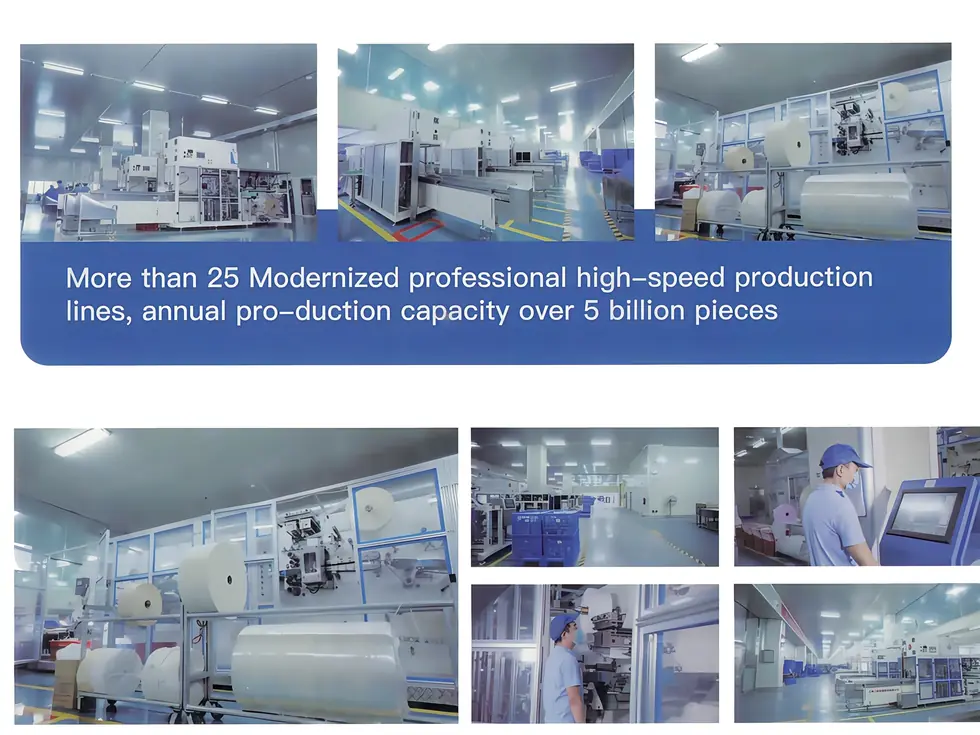
- Facility. The workshop, its cleanliness class, airflow, and how raw materials and finished goods are separated.
- Equipment. The machines, their sanitation, and whether they're maintained so the product never picks up contamination in-process.
- Materials. What actually touches skin — topsheet, absorbent core, adhesives, backsheet — and where each one comes from.
- Testing. The gates that check materials before production, equipment during production, and finished goods before they leave.
Most quality failures aren't dramatic. They're a raw material swap nobody logged, a line that wasn't cleaned between runs, or a finished lot that never got tested. The system exists to catch the boring stuff.
What counts as a qualified facility
The production environment for disposable hygiene products isn't a normal workshop. Key requirements:
- Controlled cleanliness. The production area runs under a specified dust and microbial class, with positive-pressure or filtered airflow depending on the product. This is non-negotiable for anything absorbent that sits against skin.
- Separation of zones. Raw material storage, production, packaging, and finished goods need physical separation, so cross-contamination can't happen by accident.
- Personnel hygiene. Dedicated changing areas, gowning, and hand-washing discipline before entry. People are the most common contamination vector — the system has to handle that.
Facility credibility is usually proven with certificates: GMP certified hygiene products factory status for the operation, and ISO 9001 for the quality management system. When a buyer asks what certifications a sanitary pad factory should have, these two are the starting answer.
Materials: the safety starts upstream
Safety problems are rarely born on the line. They enter with the materials. Two rules cover most of it:
- No recycled or waste material. Under the current hygiene standard (GB 15979-2024), the use of recycled and waste materials in the absorbent structure is explicitly banned. A supplier who can't show raw-material provenance is already a red flag.
- Incoming inspection of every lot. Each shipment of topsheet, core pulp or SAP, adhesive, and backsheet gets checked before it's released to production — not sampled once a quarter.
That's where sanitary pad material safety data comes from. A reputable supplier documents the material spec, the source, and the test result per lot. If a supplier can't produce a material log, assume the worst and verify.
Testing gates: incoming, in-process, finished
Quality control in this category runs three times — not once.
A sanitary pad quality control report you can actually read is the deliverable of this system. It shows the indicators tested, the results, and the standard they were measured against. If a supplier hands you a one-line "passed QC" sheet, that's not a report — that's a promise without proof.
The test panel that matters
The specific limits come from the national hygiene standard, GB 15979-2024, and the product standard for absorbent articles. The panel a safe supplier runs on finished goods includes at least:
| Category | What's checked | Why it matters |
|---|---|---|
| pH | Within range / close to neutral for skin contact | Skin-safe acidity, especially for sensitive wearers |
| Fluorescent brighteners | Not detected in paper-containing products | Common skin irritant trigger |
| Heavy metals | Lead, arsenic, mercury at trace limits | Systemic exposure through prolonged skin contact |
| Ethylene oxide residue | Tight residue limit after sterilization | Sterilization byproduct must not linger on the product |
| Microbiology | Bacterial count, fungi, and absence of coliform and key pathogens | Directly guards against the infections products can cause |
| Toxicology | Skin irritation, sensitization, and (for contacting products) mucosal tests | Proves the product doesn't irritate or sensitize |
The best suppliers go wider than the baseline — running additional indicators and tighter limits than the standard requires, then publishing the panel. For a buyer, that's the difference between "meets the standard" (everyone does) and "holds a tighter line than the standard demands" (few can prove it).
Third-party testing and certifications to demand
In-house QC is table stakes. The differentiation — and the import-clearance currency — is independent verification. For a serious supply evaluation, ask for:
- Accredited lab reports. An ISO-accredited laboratory testing the specific product to the destination market's expectations.
- Facility certificates. ISO 9001 quality management, GMP for the production environment, and whichever market-specific ones your destination requires.
- Batch traceability. A system that maps every finished lot back to its raw material lots, production date, and line — so a question about any batch can be answered in minutes, not days.
If you're evaluating an ISO certified sanitary pads factory or a GMP certified hygiene products factory, don't stop at the certificate page. Ask to see a recent sanitary napkin third party testing report for the actual product you intend to import — the certificate proves the factory passed an audit; the report proves this batch passed the test.
The goal isn't "no complaints." It's a system that catches problems first
Every year, quality incidents in the category surface publicly — products linked to allergic reactions, microbial contamination, or material that shouldn't have been there. The recurring theme in each case is usually the same: a failure upstream that no gate caught. Safety is the work of making sure that can't happen quietly.
The standard is the floor. A factory that treats the standard as the target is already behind. The ones worth buying from treat it as the starting line and keep the gates tight above it.
Frequently asked questions
What certifications should a sanitary pad factory have?
The baseline is ISO 9001 for the quality management system and GMP certification for the production environment, with product testing by an accredited third-party laboratory. For export markets, add whichever registration your destination applies to this category; the importer files it. The certificate shows the factory passed an audit; pair it with a recent product test report to see what actually shipped.
What are the safety standards for sanitary pads?
In China, the baseline is GB 15979-2024 for hygiene requirements — covering pH, fluorescent brighteners, heavy metals (lead, arsenic, mercury), ethylene oxide residue after sterilization, microbiological limits, and toxicology (skin irritation and sensitization) — plus the product standard for absorbent articles. Exporters also need to satisfy destination-market requirements. A safe supplier tests incoming materials, in-process production and finished lots against these panels.
Are disposable menstrual pants safe?
Yes, when produced under the same discipline as pads — controlled facility, inspected materials, and the full test panel on finished goods. Menstrual pants face the same hygiene standard and the same microbiological and toxicology checks. The question isn't the product category; it's whether the factory runs the same safety system across all its lines.
How do I verify a supplier's quality control claims?
Ask for three things: a recent third-party test report for the specific product you want to import, the facility certificates (ISO 9001, GMP), and a batch traceability system that maps finished lots back to raw material lots and production dates. Then ask to see the raw material inspection log. A supplier with a working QC system can produce all of it in minutes; one without it will offer explanations instead.
Request a Nafei OEM Quotation
Evaluating a factory, or building your own private-label line? Tell us your target market and product type, and we'll share the compliance framework, test panel and facility certificates that back our sanitary pads and menstrual pants production — including third-party test reports you can verify. Send your spec and estimated volume for a transparent quotation.
Photos
Send a sampling brief for Sanitary Pad Safety Standards and Production Requirements: What a Safe Factory Controls
Tell Nafei your target market, size range, absorbency preference, packaging artwork status and estimated order plan. Our team can reply with sample discussion and quotation details.
- Target market and sales channel
- Size, pack count and material preference
- Private label artwork or packaging reference
- Sample review, quantity and delivery timeline