
How Sanitary Pads Are Actually Made (the Layer Nobody Shows You)
A pad is a stack of engineered layers, not one soft thing. From the topsheet down to the backsheet, here's the real production flow — and where a factory's choices decide quality.
Share target market, size range, pack count, artwork status and order quantity for quotation.
Introduction
Buyers picture a pad as one soft cushion. It isn't — it's a precisely stacked sandwich of materials, and the order of those layers is the whole game. When a pad leaks or smells or irritates, it's almost always one layer done wrong. Here's the real build, top to bottom.
The layer stack (top to bottom)
- 1Topsheet. The layer against skin — usually a spunbond/meltblown nonwoven (PP or PE), sometimes a cotton-feel variant. Its job is let fluid through fast and stay dry. A poor topsheet repels instead of wicks, and you feel wet all day.
- 2Acquisition/distribution layer. Sits under the topsheet to pull fluid down and spread it so the core isn't hit in one spot. Skip or cheapen this and the pad tunnels and leaks.
- 3Absorbent core. The heart: fluff pulp (for softness and spread) blended with SAP (super absorbent polymer) that locks liquid into gel. The SAP-to-pulp ratio is the single biggest cost and performance lever — more SAP, thinner and drier, but pricier.
- 4Core wrap / tissue. A thin tissue or nonwoven keeps the SAP from dusting out. Weak wrap = SAP leaks onto skin.
- 5Backsheet. The leak-proof floor. Traditional PE film is silent and fully blocking; "breathable" backsheets use a microporous film that vents air but not liquid. Breathable costs more and feels less clammy.
- 6Adhesive + release paper. The strip that sticks to underwear, plus the wing glue and the peel-away paper. Adhesive failure = the pad shifts. That's a factory-spec problem, not user error.
The production flow on the line
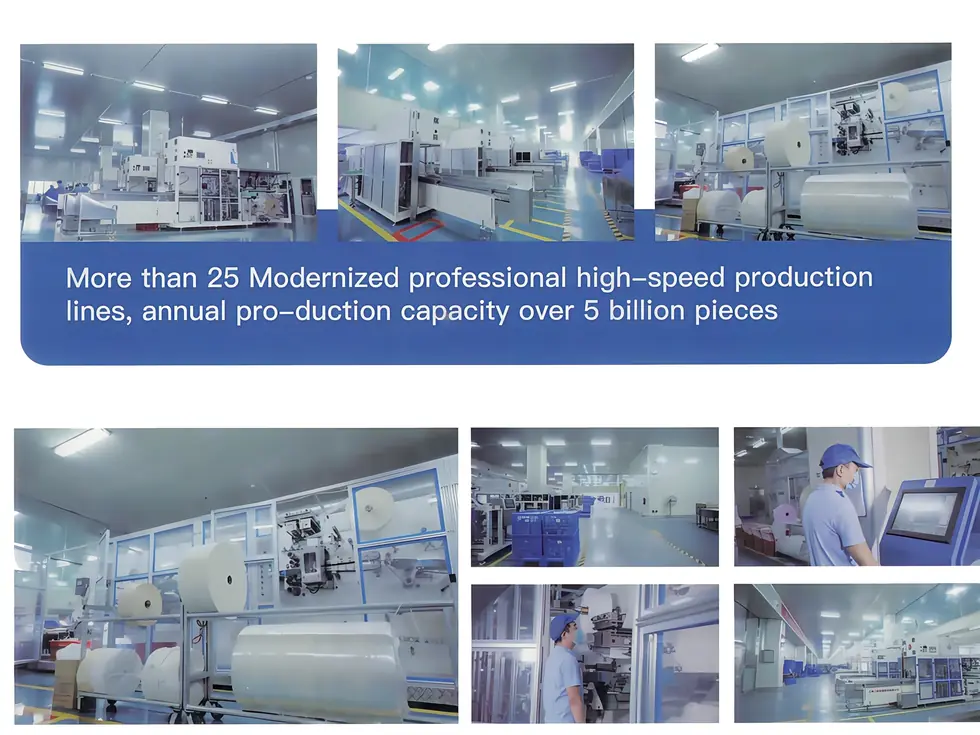
On a real pad machine, this happens in one continuous web at high speed:
- Mat forming — fluff pulp is hammer-milled and laid down, SAP metered and blended in.
- Core compression & wrap — the mix is shaped, weighed, and wrapped.
- Lamination — topsheet, acquisition layer and backsheet are pressed together around the core.
- Shaping & wing cutting — contour cuts, wing scores, and the brand emboss.
- Individual wrap & packing — each pad is folded and film-wrapped, then cartoned. The wrapper is where a lot of "premium" perception (and cost) lives.
| Layer | Does | Cheap version fails by |
|---|---|---|
| Topsheet | Wicks fluid away | Feels wet, irritates |
| Acquisition | Spreads fluid | Tunnels, central leak |
| Core (SAP+pulp) | Locks fluid | Saturation, bulge |
| Backsheet | Blocks leak, vents | Leak-through or clammy |
| Adhesive | Holds position | Shifts, folds |
Frequently asked questions
What makes one pad better than another?
Mostly the core and the backsheet. The SAP-to-fluff ratio sets how thin and dry the pad stays; the backsheet sets whether it leaks or feels clammy. A good acquisition layer stops central tunnelling. The printed topsheet pattern is the least important part, despite what packaging suggests.
Is more SAP always better?
More SAP means thinner and drier at equal absorbency, but it costs more and can feel firmer. The right ratio depends on the pad type — a thin daytime pad wants more SAP; a soft overnight pad can use more pulp for comfort. It's a spec decision, not "max it out."
Why do some pads smell or leak?
Usually a layer issue: a poor topsheet that stays wet, a weak core wrap letting SAP dust onto skin, or a backsheet that isn't sealed. Smell is more often a change-frequency habit than a material fault — but a cheap core that stays saturated will odor up faster.
Spec Your Pad, Layer by Layer
Want a pad that performs, not just prints pretty? Tell us the use case and we'll lock the core ratio, backsheet and topsheet with you before a single unit runs — so the quote reflects the product you'll actually sell. Samples and a layer spec sheet follow.
Photos
Send a sampling brief for How Sanitary Pads Are Actually Made (the Layer Nobody Shows You)
Tell Nafei your target market, size range, absorbency preference, packaging artwork status and estimated order plan. Our team can reply with sample discussion and quotation details.
- Target market and sales channel
- Size, pack count and material preference
- Private label artwork or packaging reference
- Sample review, quantity and delivery timeline