
Why a Sanitary Pad Stays Dry on the Surface — or Doesn't
2026-09-05
Ask a consumer what she wants most from a sanitary pad, and one phrase comes up again and again: a dry surface. Ask a factory how you get it, and the honest answer is: with more difficulty than most people imagine. Surface dryness is not one material. It is the outcome of an entire design.
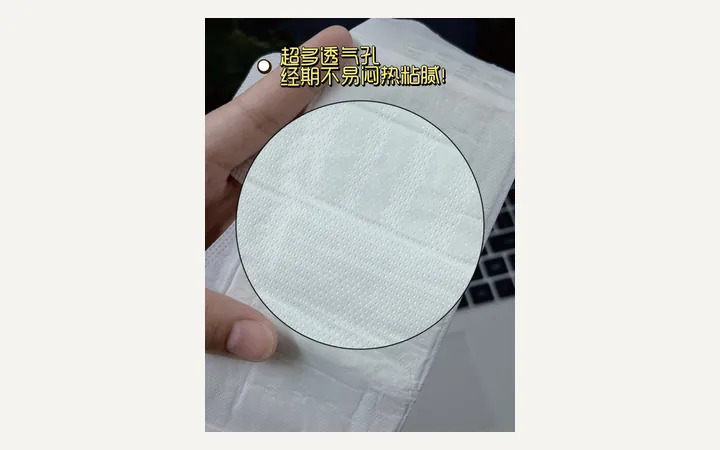
A veteran engineer who has spent over thirty years in this industry walked me through the logic, and it changed how I read a spec sheet.
The standard keeps raising the bar
National standards for pads keep tightening how the topsheet handles fluid. Years ago, a topsheet that passed a single-strike wetting test was considered acceptable: one gush of fluid, and the surface had to let it through and feel dry again. Today the expectation has moved to repeated strikes — fluid comes, the surface clears, fluid comes again, and it still has to clear. That single upgrade has quietly eliminated a large share of products that used to pass.
The topsheet has two jobs that point in opposite directions
Here is the part most people outside the industry never see. A topsheet is not one homogeneous layer. It is engineered in levels, and the levels want opposite things.
The upper level has to stay dry: fluid should not spread sideways, the wetted area should stay as small as possible, and yet the fluid must be able to go down through it. The lower level wants the exact opposite — it should spread fluid as widely as it can, because spreading is how the absorbent core gets used evenly instead of flooding one spot.
One level resists spread to keep skin contact dry. The next level promotes spread to protect the core. Reconciling those two opposite requirements is the real engineering, and it is the job of the structure between them.
The layer nobody advertises: the acquisition distribution layer
Between the topsheet and the core sits the acquisition distribution layer, or ADL. Its job is to take fluid that has come through the topsheet and move it down into the core fast, then help it spread across the core's width. A good ADL is the reason two pads with the same SAP weight can feel completely different in use.
We once saw a product fail precisely here. A client switched to a more expensive, denser acquisition material, assuming better material meant better performance. Instead, fluid sat on top of it. The layer was so efficient at holding fluid that it slowed the transfer down, the surface stayed wet, and a product that looked upgraded on paper was worse in real use.
The SAP mistake: more is not drier
The same trap exists with SAP, the superabsorbent polymer that locks fluid into gel. The instinct is: more absorbent beads, more absorption, drier surface. The veteran engineer was blunt about this. Load too much SAP and the gel that forms blocks the channels fluid needs to travel through. Fluid can no longer reach the lower core, pools on the surface, and the pad fails the exact test the extra SAP was supposed to help pass.
Absorption capacity and surface dryness are related but not the same number. A pad can have impressive total absorption and still feel wet in the first hour.
Dryness is a system, not a spec
I wrote earlier about how the topsheet, acquisition layer, and core work together. The lesson from the engineer confirmed it from another angle: the question to ask is never "which layer is best." It is "do the layers match each other."
For buyers evaluating OEM sanitary pads, this is why we encourage testing the whole product — repeated wetting, rewet against the skin, real wear time — instead of comparing single material numbers on a quote sheet. If you are specifying a custom sanitary pad, match the topsheet, ADL, and core as one system, and test the combination, not the components.
The pads that feel dry are not the ones with the most impressive single layer. They are the ones where every layer lets the next layer do its job.
Li Genyuan is the founder of Guangdong Nafei Biotechnology, a feminine hygiene OEM/ODM manufacturer in China. He writes about how pads and period pants are actually engineered.
Turn this guide into an OEM brief
Share your product direction, target market, packaging idea and sample questions. Nafei can help translate the buying guide into a practical RFQ discussion.
- Product type: period pants, sanitary pads or mixed OEM project
- Target country, channel and buyer positioning
- Size range, material preference and sample review focus
- Private label artwork, pack count and estimated quantity