
The Sanitary Pad Costs Pennies: A Factory Layer-by-Layer Breakdown
2026-09-08
A sanitary pad looks like the simplest thing you own. A strip of soft material, a strip of glue, sold for pennies. Nothing to think about.
Then you take one apart, layer by layer, and the picture changes completely. What you are holding is a small piece of materials engineering that took decades to get right: a liquid-management system thin enough to disappear under clothing, built to move fluid in one direction, lock it under pressure, stay in place while the body moves, and peel away without leaving a trace.
I have spent years around the production lines of a sanitary pad factory in China. I have watched these layers run past at more than a thousand pieces a minute. Once you see what is inside — and what each layer is fighting to do — you will never look at the few-cent pad the same way again.
Layer 1: The topsheet — move the liquid, do not hold it
The layer against your skin has one job: let fluid pass through fast, and stay dry itself.
That sounds backwards. Shouldn't the topsheet absorb? No. If the topsheet absorbs, it stores the liquid — right against your skin. The best topsheets are engineered to barely absorb at all. Their job is transfer: pull fluid down into the core in seconds and give up nothing on the way back.
This is where the surface patterns stop being decoration. The raised domes and 3D embossing you see on a modern ultra-thin sanitary pad reduce the contact area between the sheet and your skin — the parts that do not touch can breathe. The channels and curvature steer fluid toward the center of the core instead of letting it pool at the edges.
Materials vary — thermal-air-bonded nonwoven, hydrophilic-treated spunbond, cotton-touch covers. But they are all tuned toward the same contradiction: feel like nothing, and move liquid like a filter.
A quick test: if the surface still feels wet minutes after a change, the topsheet is holding liquid instead of passing it. That is a materials failure, not a heavy-flow problem.
Layer 2: The absorbent core — take it in and keep it down
Underneath sits the core: fluff pulp blended with superabsorbent polymer (SAP), the material that does the actual work.
SAP is remarkable stuff. Each granule swallows many times its weight in liquid and locks it as a gel — which is why a thin core can hold what a thick cotton wad used to. Fluff pulp plays a different role: distribution. It pulls liquid outward and spreads it, so the SAP does not saturate in one spot while the surrounding area stays bone dry.
The difference between a good core and a cheap one is structure. A resilient, lofty core drinks fast and holds under pressure — you sit, you move, nothing comes back up. A collapsed, over-compressed core lets liquid sit near the surface. The lab number we watch for this is rewet: how much liquid transfers back to the surface under a standard load. Two pads can absorb the same total volume and feel completely different, purely because of rewet.
When you remove a well-made pad and the surface looks clean, that is not luck. That is the core doing its job.
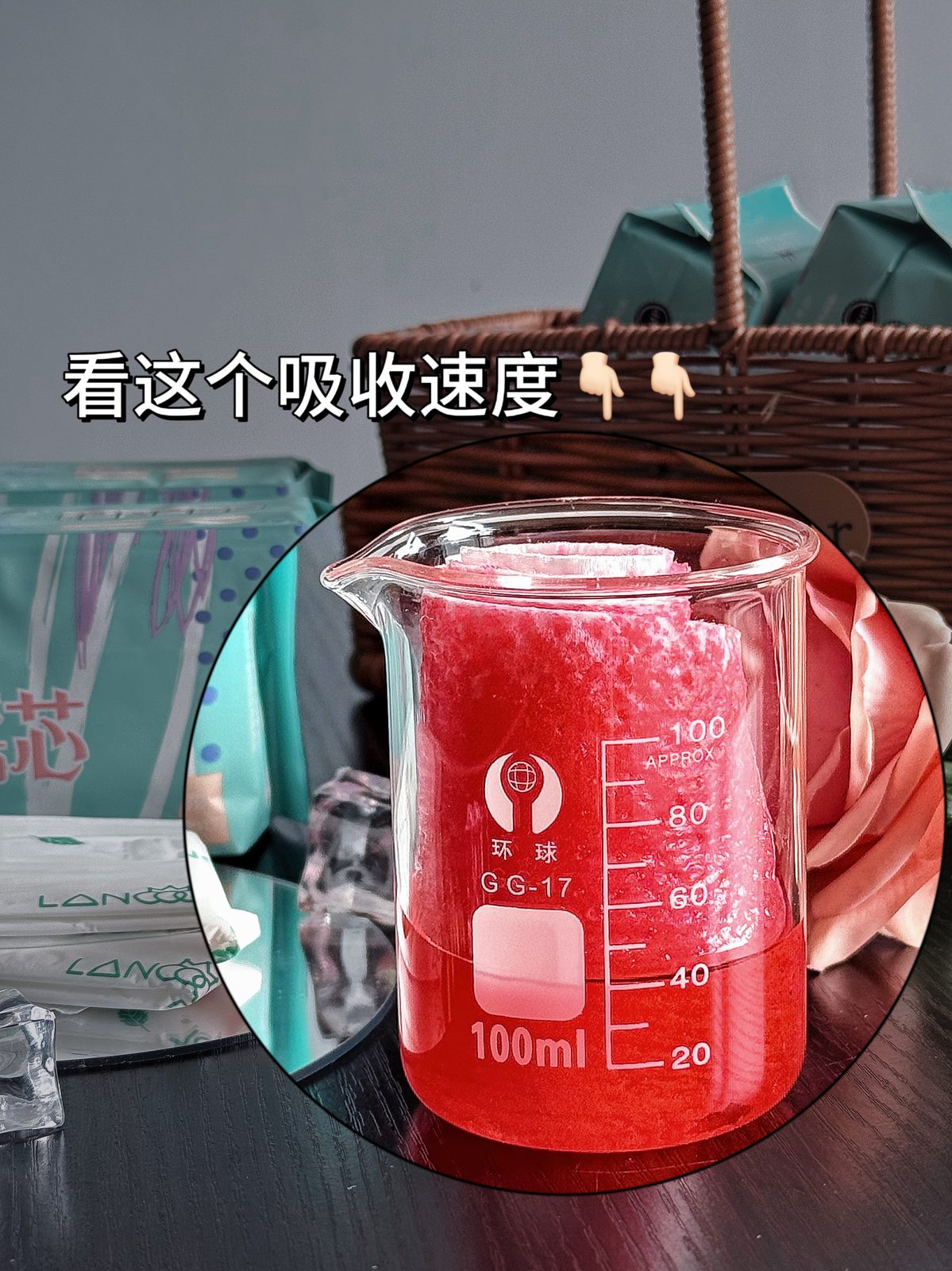
Above: a rise-and-retention check on our anion sanitary pad line — the point is not how much goes in, it is how little comes back out.
Layer 3: The adhesive — hold firmly, leave nothing behind
The back adhesive has to solve a contradiction. It must grip fabric firmly for hours, then peel off without residue, staining or fiber damage.
The industry answer is elegance through precision: coat thin, coat wide. The same total grams of adhesive, spread into a broad film measured in microns, grips over a large area and releases as one clean sheet. Doing this at line speed requires metering systems that control coating weight precisely.
Where you see glue residue, you are usually looking at the cheap version of this solution — adhesive laid down thick and narrow because the line could not meter it finely. Same raw material, opposite result.
So if you peel the release paper and see almost nothing, yet the pad stays put all day, that is not less glue. That is more control.
Layer 4: The shape — engineered for a body in motion
Here is what surprises most buyers: laboratory absorption tests are performed on pads lying perfectly flat. Your body never does that. A pad inside underwear is compressed, folded and re-angled hundreds of times a day.
So the die-cut does quiet work. Rear contours and curved end-cuts follow the body's geometry, so the pad flexes with movement instead of bunching. The adhesive layout sits where the pad actually needs anchoring — not just a uniform stripe. The wing folds are shaped to lock around the crotch of the underwear rather than flap.
There is an old factory-floor test for conformity: squeeze the pad lengthwise. If it creases upward, toward the body side, it will follow your shape when worn. If it folds flat or creases the wrong way, expect movement and leakage complaints.
The invisible fifth layer: functional chips
Open a pad from the Chinese market and you will often find a small colored patch inside the core area — like the magnetic anion chip in our Lancool line, shown below.
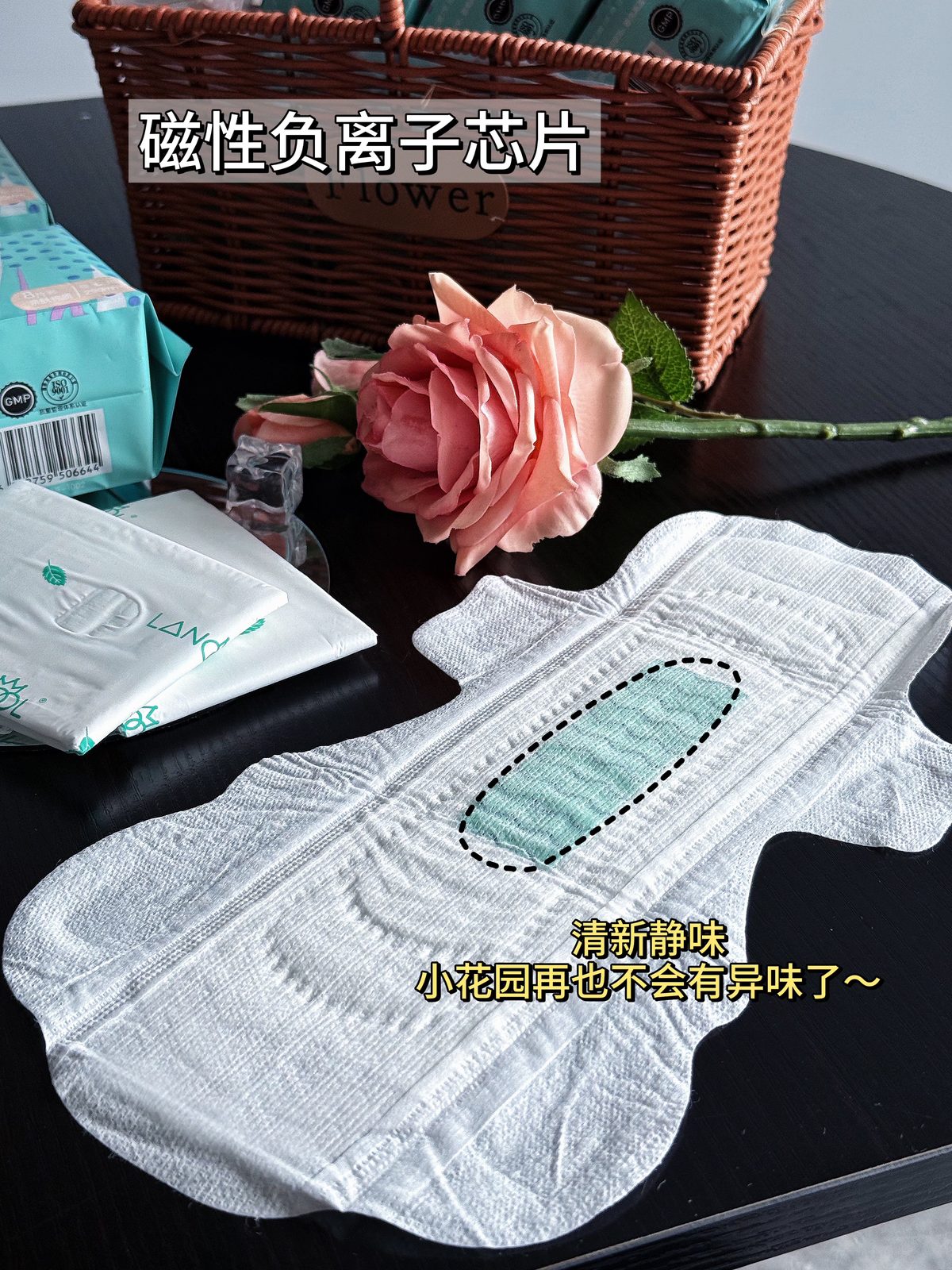
Above: the magnetic anion chip on a Lancool ultra-thin pad — a functional layer, not a medical one.
An anion sanitary pad is a comfort-oriented feature, common in the Chinese market and increasingly requested by overseas buyers. I want to be careful about how it is described, though. The chip is a functional additive, typically positioned for freshness and everyday comfort. It is not a medical feature, and no responsible manufacturer should promise health outcomes.
Our own rule is simple: get the four base layers right first. A chip cannot rescue a pad with poor rewet or a sloppy die-cut. It is a finishing touch, not a fix.
Why this matters if you are buying, not just wearing
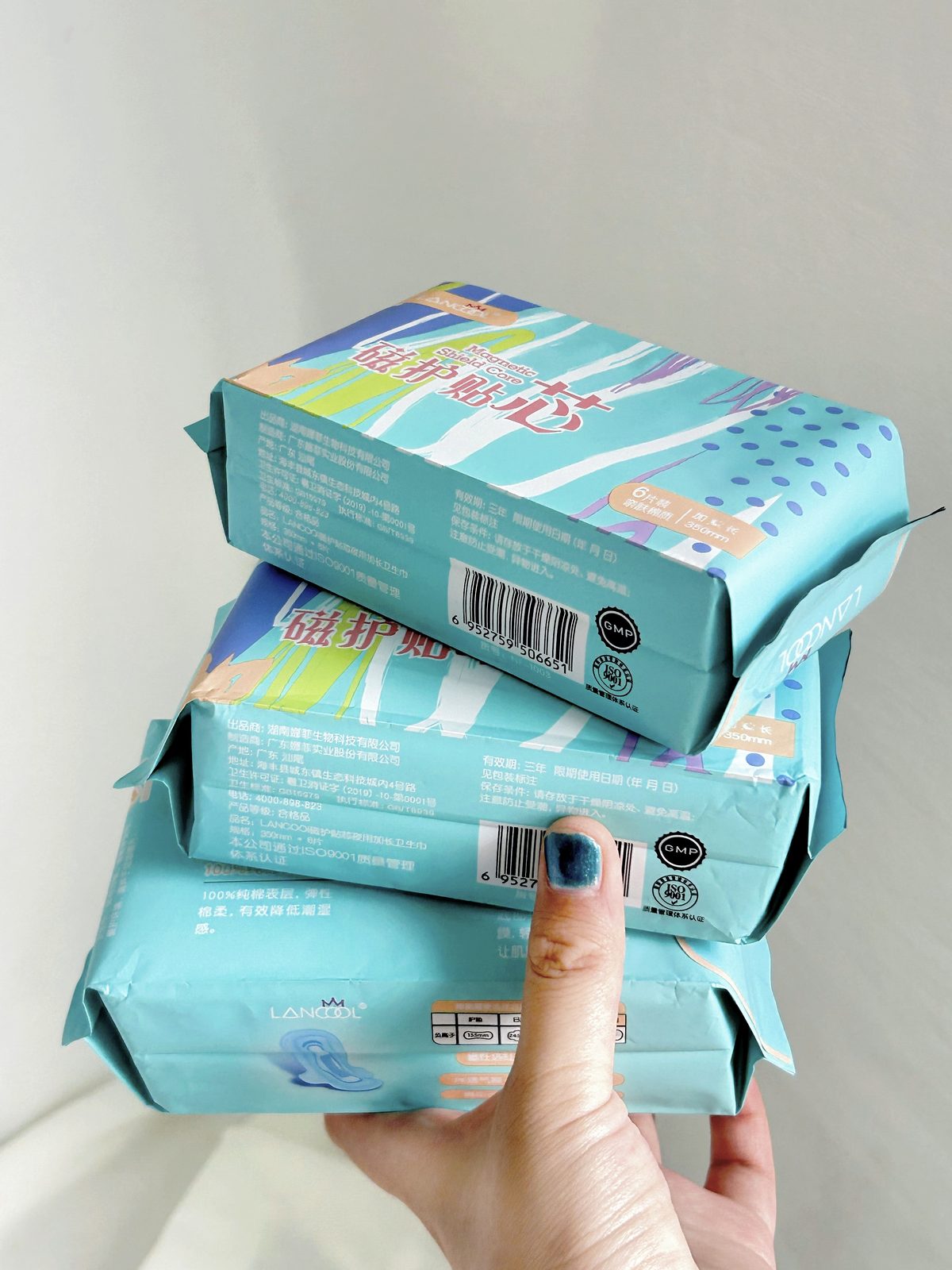
If you run a brand and you are sourcing from a sanitary pad manufacturer, these layers are exactly where quotations diverge. A lower price almost always means something got thinner — and now you know what that something can be:
- Topsheet: GSM and embossing pattern — transfer speed and dry feel
- Core: SAP ratio and structure, full core vs. half core — absorption and rewet
- Adhesive: coating weight and pattern — hold vs. residue
- Die-cut: shape, wings and adhesive layout — fit in motion
Ask any supplier to specify all four in writing. A factory that runs its own lines will answer with numbers. A trading company reselling someone else's production will answer with high quality, best price.
That single question — what is the SAP ratio and the topsheet GSM — filters more suppliers than any certificate will.
We build OEM sanitary pads and custom private-label sanitary pads on our own lines in Guangdong, from ultra-thin day pads to 420mm overnight, with or without the anion chip layer. Send us your current pad's spec — or just a photo — and we will tell you what is inside it.
The bottom line
The sanitary pad is one of the most undervalued engineering objects in daily life. Four layers, four contradictions, all solved invisibly — the topsheet transfers, the core locks, the adhesive anchors, the shape conforms. When any one of them is compromised, no amount of packaging or marketing fixes the feel.
So the next time you pick up a pad that simply works, you are holding the output of a long argument between chemists, machine engineers and accountants — and the good ones won.
By Li Genyuan - Foreign Trade Manager, Guangdong Nafei Industrial Co., Ltd. — sanitary pads manufacturer and menstrual pants OEM.
Turn this guide into an OEM brief
Share your product direction, target market, packaging idea and sample questions. Nafei can help translate the buying guide into a practical RFQ discussion.
- Product type: period pants, sanitary pads or mixed OEM project
- Target country, channel and buyer positioning
- Size range, material preference and sample review focus
- Private label artwork, pack count and estimated quantity