
How to Evaluate a Disposable Period Pants Sample: 3 Practical Tests for B2B Buyers
2026-08-04
When you source disposable period pants for import or private label, the supplier's spec sheet only tells half the story. The other half is what the product actually does in use. Experienced product engineers run a handful of low-tech checks on a sample before approving a bulk run. Here are three you can run yourself—no laboratory required.
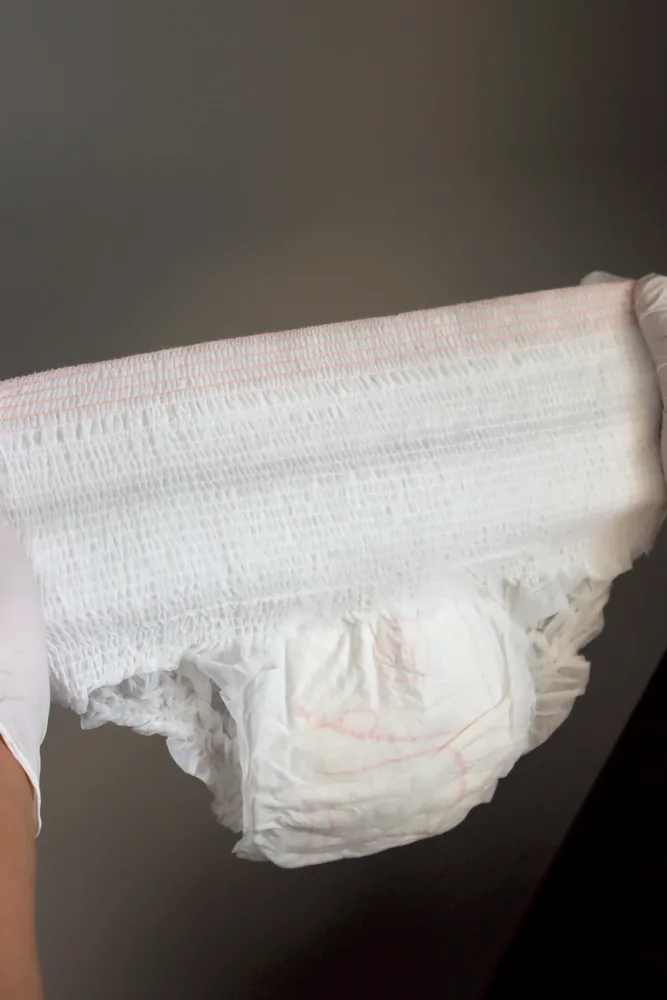
These checks are not about chasing a perfect score. They are about quickly telling a well-engineered pant from a commodity one, so you can shortlist suppliers with confidence.
Test 1 — Check color depth and liquid spread after use
After a realistic wear or absorption test, look at two things: the skin-facing top sheet and the back film.
- A light, evenly spread mark on the back film with only a small, pale patch on the top sheet usually means the fluid moved down and away from the skin quickly.
- A dark, concentrated patch that stays on the surface hints at slow wicking and more rewet—the wearer is more likely to feel damp.
The direction matters more than a number. You want liquid to leave the contact layer fast and spread through the core, which is what helps the surface stay drier during wear. (Note: no product keeps the skin perfectly dry under all conditions—this is about comparative performance between samples.)
Test 2 — Look at the top-sheet pattern and bulk
Run your finger across the top sheet. A raised, three-dimensional embossing means the material has loft: only the peaks touch the skin, so air can move underneath and the surface stays less clammy. A flat, collapsed sheet lies fully against the skin and traps warmth and moisture.
Bulk comes from the right basis weight plus a proper through-air bonding step—not from piling on raw thickness. Pair this with a well-designed distribution layer so fluid is carried away from the contact point instead of pooling beneath it.
Test 3 — The pinch test: does it fold up or down?
Grip the sample and squeeze it the way a body would. If it creases upward (toward the body), it tends to stay in contact with the skin and move with you—less side leakage and less chafing. If it creases downward (away from the body), a gap opens and fluid has more room to escape.
Structural details are what make a pant crease up rather than down: tail shape, a vent cut in the core, and a front-to-back thickness gradient. This is exactly the kind of engineering that separates a cheap commodity pant from a well-built one, and it is easy to feel with your own hands on a sample.
What these tests reveal about the manufacturer
A supplier whose samples consistently pass these checks is usually one that controls its materials and process: top-sheet denier, SAP grade and loading, distribution-layer pairing, embossing, and bonding. The three "low-tech" tests are really proxies for three engineering choices:
- A low-rewet top sheet that lets fluid pass quickly.
- A breathable backsheet and lofty structure that reduce warmth and clamminess.
- A SAP core and distribution layer tuned so fluid spreads instead of pooling.
When you evaluate a factory, ask to see the production line and the material specification—not just a price. A partner that can explain why a sample behaves the way it does is one you can build a private-label program on. See how a controlled manufacturing base supports this on our factory capability page, or start a conversation through our OEM/ODM service.
A note on materials behind the results
Cooling variants use a cool-feel top sheet for a fresher sensation; they are comfort features, not medical or therapeutic claims. If you are comparing styles, our cooling disposable menstrual pants and ultra-thin disposable period underwear are good references for how top-sheet and core choices show up in finished products. For longer wear, the overnight style demonstrates rear coverage and core spread designed for extended use.
Frequently asked questions
How many samples should I test before ordering?
Test at least 2–3 units per variant, taken from a production run rather than a hand-made prototype, under realistic conditions. Consistency across units matters as much as the average result.
Can these tests replace lab certificates?
No. They are fast screening checks to compare suppliers. Always still request ISO and the compliance documents required for your target market—see our about page for the certifications we hold.
What is the most common quality miss in cheap period pants?
Slow wicking and high rewet. Fluid lingers on the surface, so the wearer feels damp and warmer, and the top-sheet mark stays dark after use.
Should I test daytime and overnight styles differently?
Yes. Overnight styles should show even more spread across the core and good rear coverage. On the sample, check the tail shape—a contoured rear follows the body and shifts less during sleep.
How do I compare two suppliers' samples fairly?
Use the same fluid volume, the same wear time, and the same three checks side by side. Then look at the top-sheet mark and the back-film spread: the better sample shows a smaller, paler top mark and a wider, lighter spread underneath.
Tell us your target market and volume, and we will ship production-run samples you can run these three tests on. Contact our team →
Turn this guide into an OEM brief
Share your product direction, target market, packaging idea and sample questions. Nafei can help translate the buying guide into a practical RFQ discussion.
- Product type: period pants, sanitary pads or mixed OEM project
- Target country, channel and buyer positioning
- Size range, material preference and sample review focus
- Private label artwork, pack count and estimated quantity