Sanitary Pads Manufacturer, Supplier, or Factory: Which One Do You Actually Need?
Stop guessing. Learn how to tell a real sanitary pads manufacturer from a middleman, and what factory direct really means when sourcing from China.
Share target market, size range, pack count, artwork status and order quantity for quotation.
Introduction
Most buyers type "sanitary pads manufacturer," "sanitary pads supplier," and "sanitary pads factory" into Google like they mean the same thing. They don't.
Pick the wrong one and you're either paying a 20% markup to someone who never touches the production line, or you're locked into a plant that can't change a top sheet without a three-week headache. I see it every month — a distributor emails us after getting burned by a "factory" that was really a trading desk with a nicer website.
Here's the part most sourcing guides skip: at Nafei we're both. Guangdong Nafei Biotechnology runs the brand and export side. Guangdong Nafei Industry runs the manufacturing floor down in Shanwei. The export carton in the photo above spells it out — 出品商 (brand holder) and 制造商 (actual maker) are two different legal entities. That split is completely normal in China. It's also exactly why you shouldn't trust a single label.
Manufacturer, supplier, factory — what the words really buy you
- Manufacturer owns or directly controls the production lines, the staff, and the quality system. They can change the absorbent core, the SAP ratio, the packaging, the specs. If you want a product that's yours, this is the relationship you want.
- Supplier just means "the company that sells you the goods." It could be the manufacturer. It could be a trader. It could be a distributor selling another brand's stock. The word tells you about the sales channel, not the production depth.
- Factory is the physical plant. But here's the trap: a "factory" might only do cut-and-sew or final packing while sourcing the cores and films from three other vendors. Having four walls doesn't mean having control.
So when someone claims "factory direct," the honest follow-up is: whose factory, and what exactly happens inside it?
Why "factory direct" is overrated (and when it isn't)
Trading companies get a bad rap. Some of them earn their margin — they consolidate small MOQs across several plants, handle translation, and catch QC issues before the container leaves. If you're buying off-the-shelf sanitary napkins and your volume is modest, a sharp supplier can save you time.
But the moment you need a custom formulation, a cool-feel top sheet, or a specific SAP ratio, you want the manufacturer on the call. One buyer came to us wanting a lighter, faster-wicking core for hot climates. A trader would've just relayed the message and hoped. We re-ran the lamination trial on our own line in nine days. That's the difference between forwarding a request and owning the answer.
How to spot a real sanitary pads manufacturer
- The business license. Look for 制造 / 生产 (manufacturing / production) in the scope, not just 贸易 (trading) or 销售 (sales).
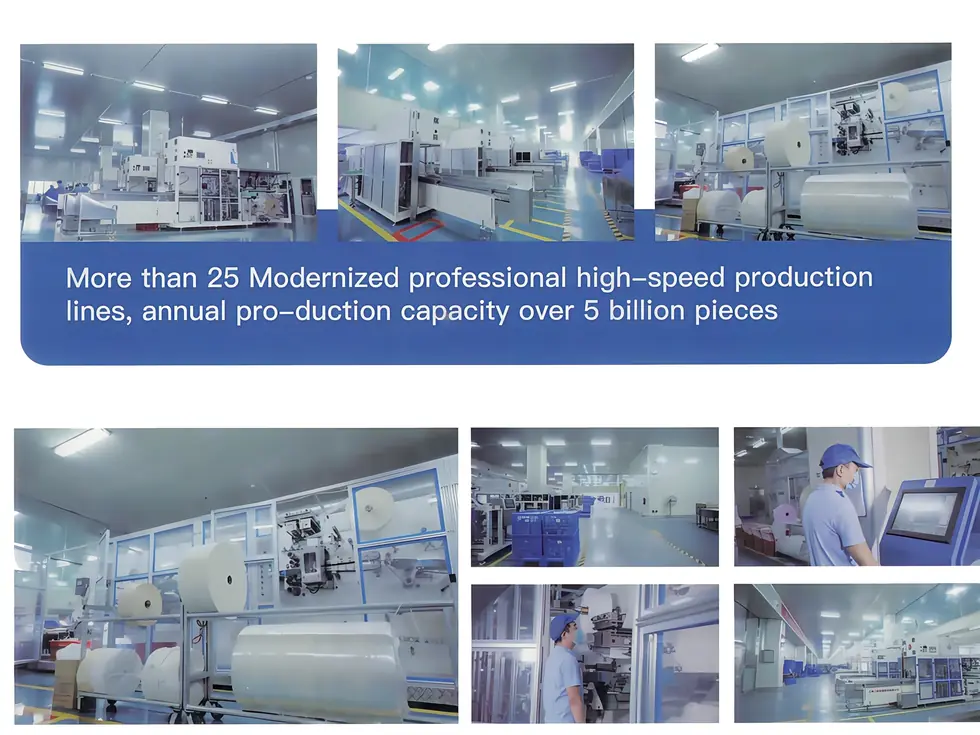
- Line ownership. A real manufacturer will show you the production lines — video tour, not just staged photos.
- Certifications that mean something. ISO 9001, ISO 14001, ISO 45001, and GMP are the baseline for a credible China feminine hygiene manufacturer. Skip any vendor waving certificates they can't name the issuing body for.
- Standard compliance. Ask about GB/T 8939. The version in force right now is the 2018 edition. A 2025 revision exists but doesn't take effect until January 1, 2027 — anyone claiming "fully compliant with 2025" today is either confused or overselling.
- Unbranded samples. Request product pulled from current production, not the glossy marketing pack. Real makers aren't afraid of that.
What our export cartons actually tell you
Look at the shipping carton again. It's labeled for the Middle East market — Hussein Al-Naimi, Arabic marking, 96 packs per case. The 出品商 (Guangdong Nafei Biotechnology) is the exporter of record; the 制造商 (Guangdong Nafei Industry) is who actually made it.
For you as a buyer, that structure is a good sign, not a red flag. It means there's a company legally standing behind the export paperwork, and a separate entity with the capacity to produce. When you scale an order, you're not betting on one overworked office. You're working with a brand holder that handles compliance and communication, backed by a plant that handles volume.
OEM, ODM, or ready stock — pick the model before you pick the partner
- OEM — your brand, our existing product. Fastest path to market, lowest development risk.
- ODM — we design around your brief. More lead time, far more differentiation, and it only works with a manufacturer, not a reseller.
- Ready stock / wholesale — our brand, your market. Lowest MOQ, fastest ship, but you're selling someone else's name.
If your goal is building a private label, "sanitary pads supplier" searches will surface a mix of all three. Filter hard for the OEM/ODM capability before you waste a phone call.
Questions to ask before you fly to China
- What's your real monthly capacity for sanitary napkins versus menstrual pants? They scale differently — don't assume.
- Can I see your raw-material incoming QC records?
- Who runs the absorbency and pH testing — in-house lab or third party?
- What's the standard MOQ, and will you do a paid trial run?
- How do you handle a defective batch after it's on the water?
A genuine manufacturer answers these without squirming. A middleman stalls on the technical ones.
FAQ
What's the difference between a sanitary pads manufacturer and a supplier?
A manufacturer makes the product and controls the specs. A supplier is whoever sells it to you — which may or may not be the maker. Always ask which one you're talking to.
Is a factory cheaper than a trading company?
Not automatically. A trader earning a 10% margin can still beat a factory's price if the factory has high overhead or won't run your small order efficiently. Price depends on volume, not the job title.
Can I visit the factory before ordering?
You should. Any sanitary pads manufacturer worth your time will arrange a video call on the floor at minimum, and a plant visit if you're placing a serious order.
What certifications should a China sanitary pads manufacturer have?
ISO 9001 (quality), ISO 14001 (environment), ISO 45001 (safety), and GMP are the realistic baseline. Demand to see the actual certificates, not just logos on a website.
How long does OEM sampling take?
For an existing product under your brand, usually 1–2 weeks including custom packaging. A modified core or new structure adds development time. Push for a concrete timeline in writing.
If you're evaluating a sanitary pads manufacturer, supplier, or factory for your market, don't guess from a website. Talk to our OEM team or see what our lines actually produce. We'd rather show you the floor than describe it.
Photos
Send a sampling brief for Sanitary Pads Manufacturer, Supplier, or Factory: Which One Do You Actually Need?
Tell Nafei your target market, size range, absorbency preference, packaging artwork status and estimated order plan. Our team can reply with sample discussion and quotation details.
- Target market and sales channel
- Size, pack count and material preference
- Private label artwork or packaging reference
- Sample review, quantity and delivery timeline