Why Sanitary Pad Back Adhesive Can Leave Residue or Fail to Hold
2026-06-29
Anyone who has used sanitary pads knows the two frustrating outcomes. Sometimes the pad does not hold well enough: the wings lift, the edge curls, and the pad shifts after walking for a while. Sometimes the opposite happens: when the pad is removed, adhesive residue stays on the underwear in small pieces that are difficult to clean.
This is not only a consumer feeling. It is a real product balance. A sanitary pad needs enough adhesive force to stay in place, but the adhesive also needs to peel away cleanly without breaking and leaving part of itself on the fabric.
The Contradiction: Hold Firmly, Peel Cleanly
To hold firmly, the adhesive needs enough contact with the underwear fabric. To peel cleanly, the adhesive body needs to stay together during removal. These two requirements pull in different directions.
If the adhesive is too weak, the pad may move. If the adhesive is too concentrated and thick, part of it may transfer to the underwear during peeling. This is why a buyer should not review pad fixation only by asking for a stronger adhesive.
The Better Direction: Spread the Adhesive Thinner and Wider
The useful improvement is often not simply changing the adhesive formula. It is changing the adhesive shape on the backsheet.
When the same adhesive amount is applied in a narrow and thick line, the adhesive layer is easier to break during removal. When the adhesive is spread thinner and over a larger area, the peeling force becomes more even. The pad can hold more steadily while reducing the chance of visible residue.
Thick and narrow is easier to leave residue
A thick adhesive strip may look simple to control, but it can transfer more easily to fabric because the adhesive body is not distributed evenly.
Thin and wide is easier to remove cleanly
A thin and wider adhesive pattern may be almost invisible, but it can still feel tacky by touch. This is often a more refined back adhesive direction for sanitary napkin OEM samples.
| Back adhesive pattern | Buyer observation | OEM meaning |
|---|---|---|
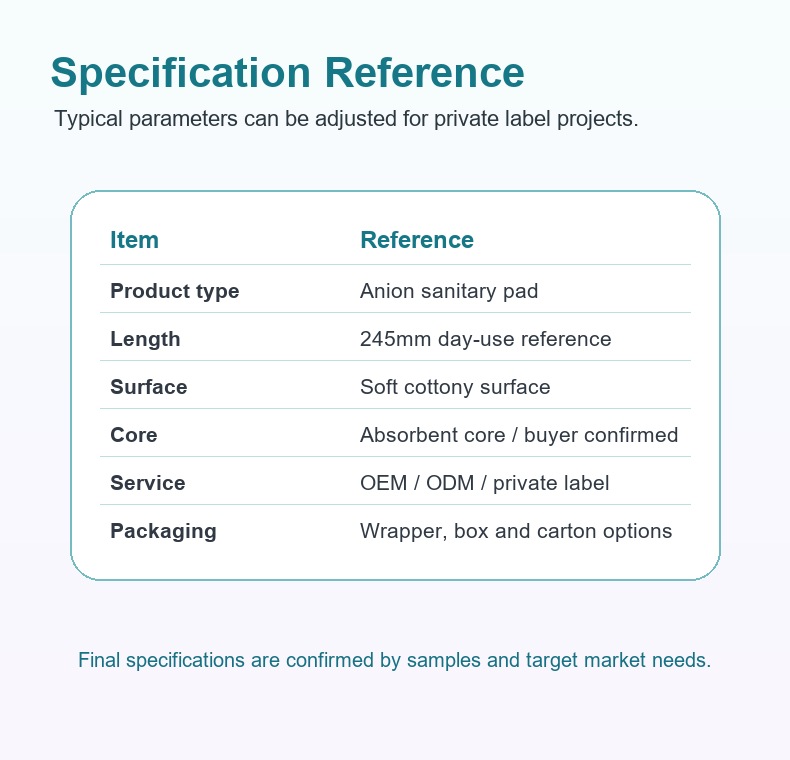
| Thick and narrow | May feel strong at first | Higher chance of uneven peeling or residue |
| Thin and wide | May be less visible but still tacky | More even force distribution during removal |
| Uneven coating | Some areas hold, some areas lift | Coating precision or process control needs review |
| Approved sample | Tested on several underwear fabrics | More realistic than checking one dry sample only |
The Hard Part Is Not the Idea. It Is Factory Consistency.
The principle is not complicated. The hard part is making every pad in bulk production carry a consistent adhesive amount, width and thickness.
This is where equipment precision matters. A metering pump in the adhesive coating process helps control how much adhesive is applied to each pad. If the flow precision is not stable, the factory may choose a thicker and narrower adhesive line because it is easier to control. But that choice can increase the residue risk.
With better flow control and coating precision, the adhesive can be applied more evenly, thinner and wider. The buyer may not see this detail before opening the product, but the user feels the result during removal.
Underwear Fabric Is Another Variable
One pad does not meet one single fabric. It may be used with cotton, modal, synthetic blends, seamless underwear and many other textures. A back adhesive that works well on cotton may behave differently on smooth synthetic fabric.
This is why the goal is not to promise that the problem can disappear in every possible situation. The realistic goal is to reduce how often it happens by improving coating precision, adhesive distribution and fabric compatibility review.
What OEM Buyers Should Check Before Approval
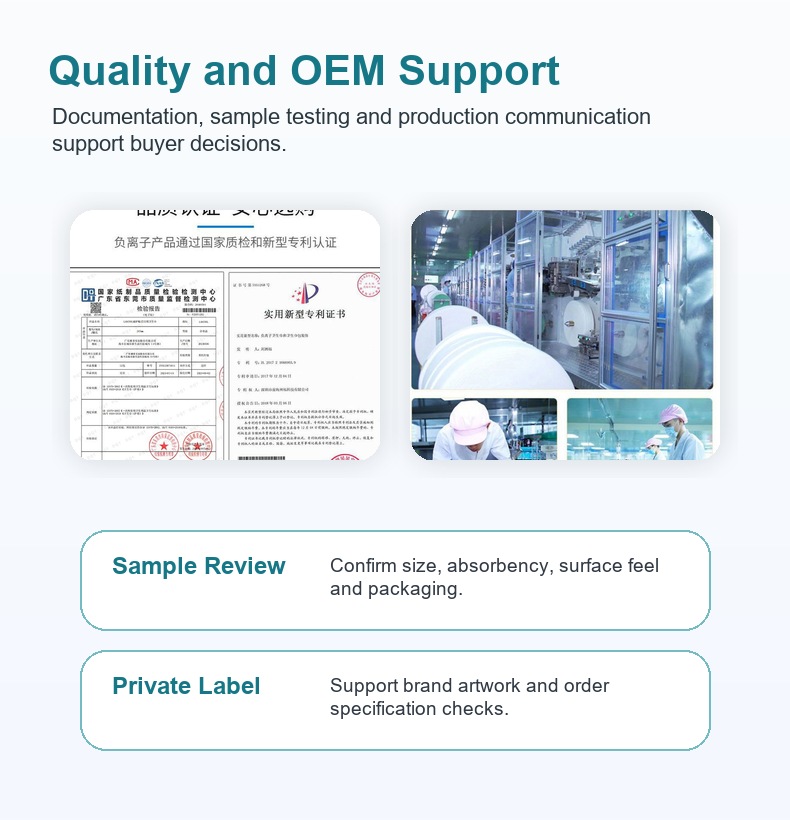
Back adhesive quality is difficult to judge on a shelf. Buyers should review it during sampling and record the result before confirming private label production.
Test more than one fabric
Use cotton, modal-like and synthetic underwear fabrics when comparing samples. A single test fabric is not enough for a broad market.
Check both fixation and removal
Do not only ask whether the pad sticks strongly. Also check whether it peels away cleanly and whether the wing area curls after movement.
Ask about coating control
For serious OEM projects, ask the supplier how adhesive amount, coating width and production consistency are controlled.
Internal Link Path
For related sanitary pad sourcing, review the sanitary napkin category, compare 245mm anion sanitary pad samples, and read Ligenyuan OEM Sourcing Column.
FAQ
Is adhesive residue always caused by bad adhesive?
Not always. Residue can be affected by adhesive pattern, coating thickness, peeling force and underwear fabric.
Should buyers simply request stronger adhesive?
No. Stronger adhesive alone may improve holding but can make clean removal harder. The adhesive pattern and coating control should be reviewed together.
Can OEM sample review reduce this problem?
Yes. Testing several fabrics and checking both fixation and removal can help buyers choose a more balanced sample before bulk order.
Discuss Sanitary Pad Back Adhesive With Nafei
Contact Ligenyuan for sanitary pad OEM discussion: WhatsApp: +86 13508489525 | Email: ligenyuan901@gmail.com | Send an inquiry.
Turn this guide into an OEM brief
Share your product direction, target market, packaging idea and sample questions. Nafei can help translate the buying guide into a practical RFQ discussion.
- Product type: period pants, sanitary pads or mixed OEM project
- Target country, channel and buyer positioning
- Size range, material preference and sample review focus
- Private label artwork, pack count and estimated quantity